
 pays (is liable)
 does not pay (is exempt)
 pays half
 pays what it benefited
Mishnah 1: A tam ox that gores several oxen
A tam ox pays only from its own body. When it gored several oxen in turn, Rabbi Meir has the last victim paid first; Rabbi Shimon has the victims share.
The case
- An ox gored four or five oxen, one after another. The owner pays the owner of the last ox injured; if money remains, the one before; and so on. The last benefits, according to Rabbi Meir.
Rabbi Shimon
- An ox worth 200 gored an ox worth 200 and the carcass is worth nothing: each owner gets 100. If it gores a third worth 200: the last gets 100, the previous 50. A fourth: the last 100, the previous 50, and the first two 25 each.
The two views
- Rabbi Meir: the injured owner seized the ox to collect his half damages and so became its paid guard; if it then gores again, the later victim is paid from what remains of it. Rabbi Shimon: the injured owner and the ox's owner become partners in it.
- The Gemara: Rabbi Meir follows Rabbi Yishmael (the injured is a creditor of the damager), Rabbi Shimon follows Rabbi Akiva (the injured becomes a partner in the ox).
Three oxen injured in turn (each worth 200)
| Owner of the injuring ox keeps | First ox | Second ox | Third ox | |
|---|---|---|---|---|
| Rabbi Meir | 0 | 0 | 100 | 100 |
| Rabbi Shimon | 25 | 25 | 50 | 100 |
שור שנגח ארבעה וחמשה שוורים זה אחר זה ישלם לאחרון שבהם. ואם יש בו מותר יחזיר לשלפניו. ואם יש בו מותר יחזיר לשלפני פניו. והאחרון אחרון נשכר דברי רבי מאיר.
רבי שמעון אומר שור שוה מאתים שנגח שור שוה מאתים ואין הנבלה יפה כלום זה נוטל מנה וזה נוטל מנה. חזר ונגח שור אחר שוה מאתים האחרון נוטל מנה ושלפניו זה נוטל חמשים זוז וזה נוטל חמשים זוז. חזר ונגח שור אחר שוה מאתים האחרון נוטל מנה. ושלפניו חמשים זוז ושנים הראשונים דינר זהב:
An ox that is an unattested danger (tam)a tam (unattested danger) that gored four or five oxen one after the other—its owner shall pay the last of them; and if there is surplus in it, he shall return it to the previous one; and if there is surplus in it, he shall return it to the one prior to the previous one. The latest gains; this is the statement of Rabbi Meir.
Rabbi Shimon says: An ox worth two hundred dinars that gored an ox worth two hundred dinars, and the carcass is worthless—this one takes one hundred dinars and that one takes one hundred dinars. If it again gored another ox worth two hundred dinars, the last one takes one hundred dinars, and of the previous one, this one takes fifty dinars and that one takes fifty dinars. If it again gored another ox worth two hundred dinars, the last one takes one hundred dinars, the previous one takes fifty dinars, and the first two take one gold dinar each.
Mishnah 2: An attested danger for some things only
An ox can be an attested danger to one kind of victim and a tam to another, or on one day and not another. For the first it pays full damages, for the other half.
By kind of victim
- An ox that is an attested danger to its own kind but not to others, to people but not to beasts, to children but not to adults: for that for which it is an attested danger, full damages; for the rest, half.
- An ox attested as a danger to its own kind (for example, to gore oxen) is not thereby attested as a danger to other kinds.
- For example, an ox seen standing with horses and camels and not goring is not an attested danger to those.
By day
- Rabbi Judah: an ox that is an attested danger on the Sabbath but not during the week pays full damages for Sabbaths and half damages for weekdays.
- It becomes a tam again after it refrains from injury for three Sabbath days.
Full or half damages
| The ox is an attested danger | Not an attested danger | The owner pays |
|---|---|---|
| to its own kind | to other kinds | full for the first, half for the second |
| to people | to beasts | full for the first, half for the second |
| to children | to adults | full for the first, half for the second |
| on the Sabbath (Rabbi Judah) | during the week | full on Sabbaths, half on weekdays |
שור שהוא מועד למינו ואינו מועד לשאינו מינו. מועד לאדם ואינו מועד לבהמה. מועד לקטנים ואינו מועד לגדולים. את שהוא מועד לו משלם נזק שלם ואת שאינו מועד לו משלם חצי נזק.
אמרו לפני רבי יהודה הרי שהיה מועד לשבתות ואינו מועד לחול.
אמר להם לשבתות משלם נזק שלם לימות החול משלם חצי נזק. אימתי הוא תם. משיחזור בו שלשה ימי שבתות:
An ox that is an attested danger (mu'ad)a mu'ad (attested danger) with regard to its own species but is not an attested dangera mu'ad with regard to other species; an attested dangera mu'ad with regard to people but not an attested dangera mu'ad with regard to animals; an attested dangera mu'ad with regard to small ones but not an attested dangera mu'ad with regard to large ones—for that with regard to which it is an attested dangera mu'ad, he pays full damage, and for that with regard to which it is not an attested dangera mu'ad, he pays half the damage.
They said before Rabbi Yehuda: What if it is an attested dangera mu'ad with regard to Shabbatot but is not an attested dangera mu'ad with regard to weekdays?
He said to them: For Shabbatot he pays full damage, and for weekdays he pays half the damage. When is it rendered an unattested danger (tam)a tam (unattested danger) again? When its behavior reverts for three Shabbatot.
Mishnah 3: Property of the Temple, of a gentile
An Israelite's ox that gores a sacred ox or a gentile's ox is exempt. A gentile's ox that gores an Israelite's pays full damages, a tam or not.
The cases
- An Israelite's ox that gored an ox of the Temple, or the Temple's that gored an Israelite's: exempt, since the verse says "his neighbour's ox" (Exodus 21:35), not the Temple's.
- An Israelite's ox that gored a gentile's: exempt. A gentile's ox that gored an Israelite's, a tam or not: full damages.
Why
- For the gentile cases Kehati gives reasons: the Gemara says the seven commandments of Noah were not kept by the nations, so their property was released to Israel; Rambam says it is a fine, since gentiles do not guard against damage; Meiri says it applies to nations not bound by religious norms.
שור של ישראל שנגח שור של הקדש ושל הקדש שנגח לשור של ישראל פטור. שנאמר (שמות כא, לה) שור רעהו ולא שור של הקדש.
שור של ישראל שנגח לשור של עובד כוכבים פטור. ושל עובד כוכבים שנגח לשור של ישראל בין תם בין מועד משלם נזק שלם:
An ox of a Jew that gored a consecrated ox, or a consecrated ox that gored an ox of a Jew—he is exempt, as it is stated: "the ox of another," but not a consecrated ox.
An ox of a Jew that gored an ox of a gentile—he is exempt. But an ox of a gentile that gored an ox of a Jew, whether an unattested danger (tam)a tam (unattested danger) or an attested danger (mu'ad)a mu'ad (attested danger), pays full damage.
Mishnah 4: Oxen of a deaf-mute, a person with psychosis, a minor
The owner of a sound ox who injures the ox of a deaf-mute, person with psychosis or minor pays. Their ox that injures a sound person's ox: exempt. The court appoints a guardian.
Who pays
- An ox of a person of sound senses that gored the ox of a deaf-mute, person with psychosis or minor: obligated. The reverse: exempt.
A guardian, and becoming sound
- If their ox gored, the court appoints a guardian, and the ox is warned in front of him.
- If the deaf-mute becomes of sound senses, the person with psychosis recovers, or the minor comes of age: Rabbi Meir says the ox is a tam again; Rabbi Yose says it remains as it was.
- The Gemara gives Rabbi Meir's reason: a change of owner changes the ox's status.
The arena ox
- An ox trained for the stadium is not liable to death, as it says "when it will gore" and not "when others cause it to gore".
Whose ox, whose ox
| Whose ox gored | Whose ox was gored | The owner of the goring ox |
|---|---|---|
| a person of sound senses | a deaf-mute, person with psychosis or minor | pays |
| a deaf-mute, person with psychosis or minor | a person of sound senses | exempt |
שור של פקח שנגח שור של חרש שוטה וקטן חייב. ושל חרש שוטה וקטן שנגח שור של פקח פטור.
שור של חרש שוטה וקטן שנגח. בית דין מעמידין להן אפוטרופוס. ומעידין להן בפני אפוטרופוס. נתפקח החרש. נשתפה השוטה. והגדיל הקטן. חזר לתמותו דברי רבי מאיר.
רבי יוסי אומר הרי הוא בחזקתו.
שור האצטדין אינו חייב מיתה שנאמר (שמות כא, כח) כי יגח ולא שיגיחוהו:
If an ox of a competent person gored an ox of a deaf-mute, a person with psychosis, or a minor, he is liable. But if an ox of a deaf-mute, a person with psychosis, or a minor gored an ox of a competent person, he is exempt.
If an ox of a deaf-mute, a person with psychosis, or a minor gored, the court appoints a steward for them, and testimony is given against them in the presence of the steward. If the deaf-mute regained his hearing, the person with psychosis became competent, or the minor reached majority, it reverts to its tam status; this is the statement of Rabbi Meir.
Rabbi Yosei says: It retains its previous status.
A stadium ox is not liable to death, as it is stated: "if an ox gores," but not if others induced it to gore.
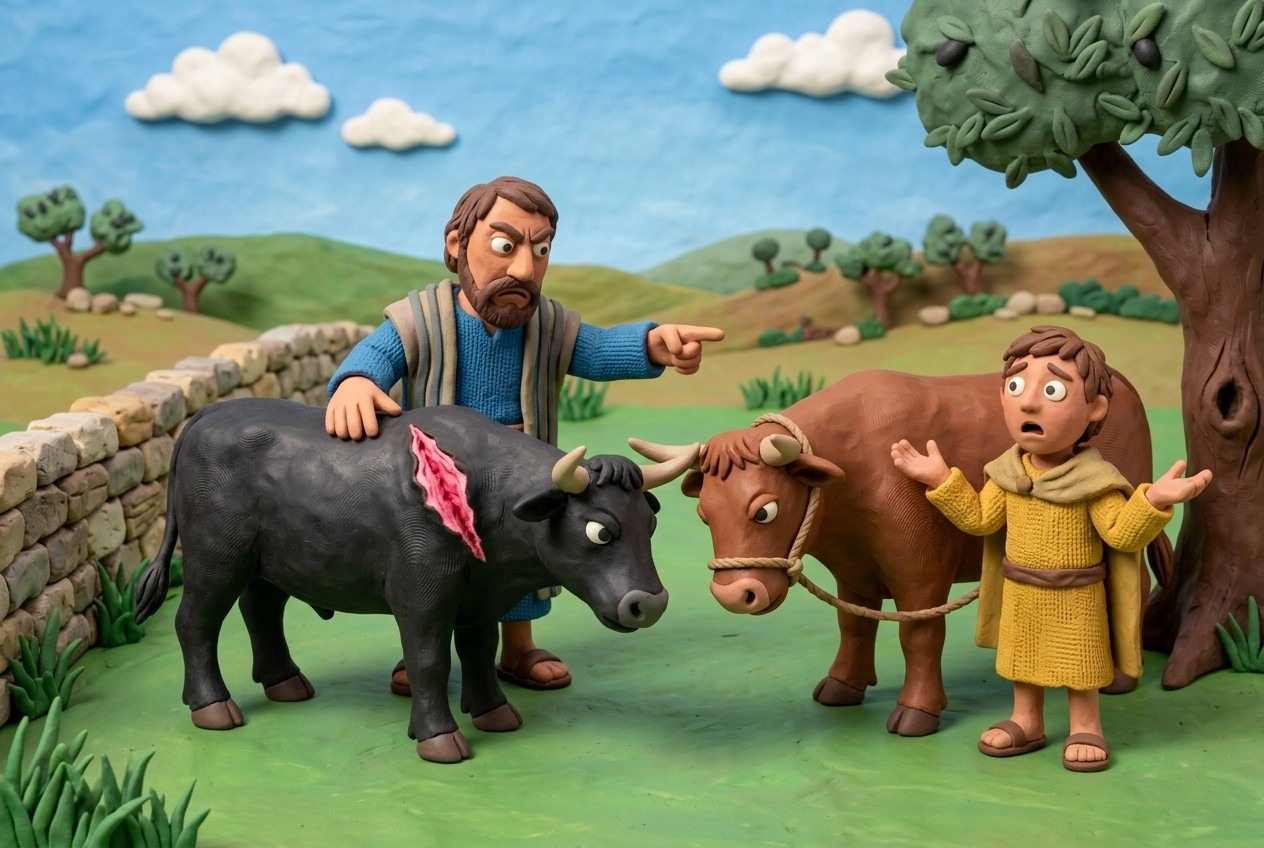
 does not pay?
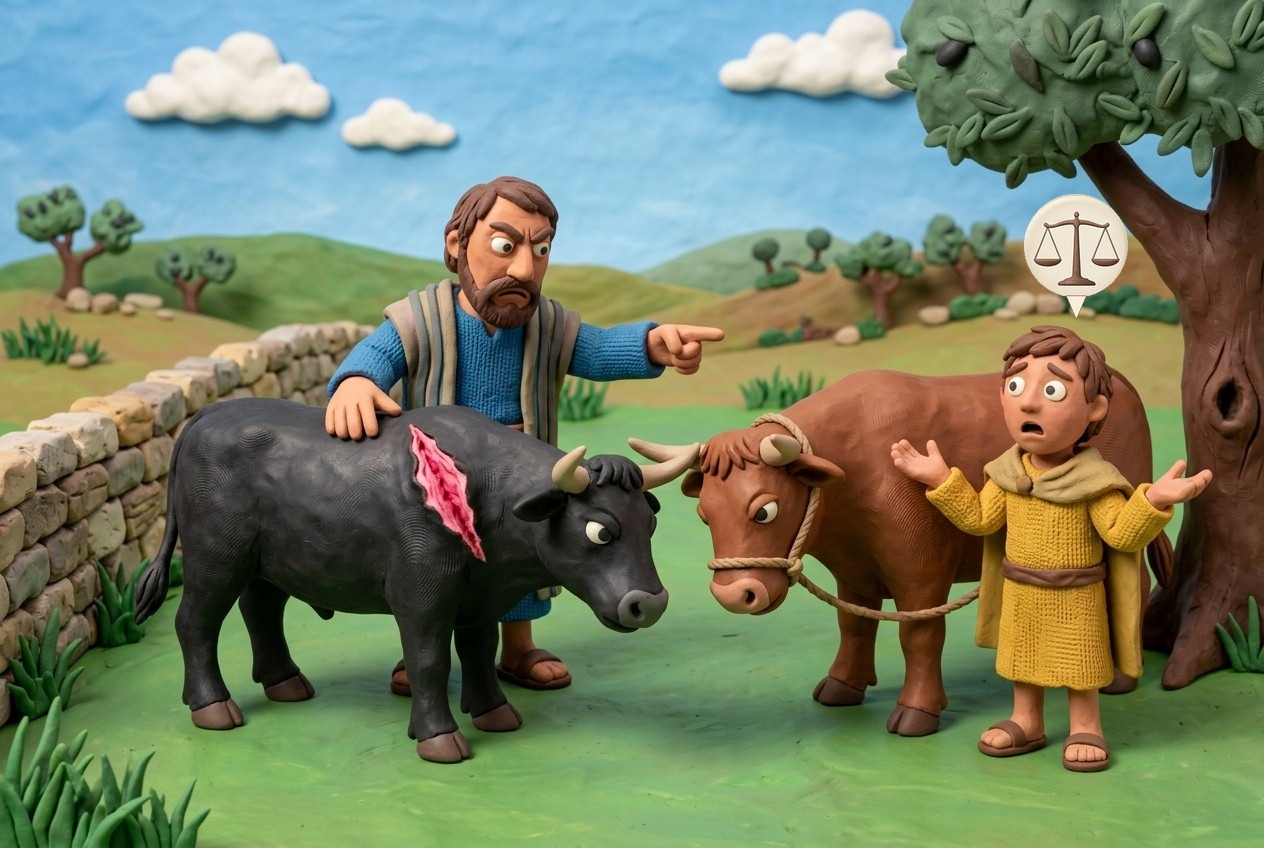 does not pay?
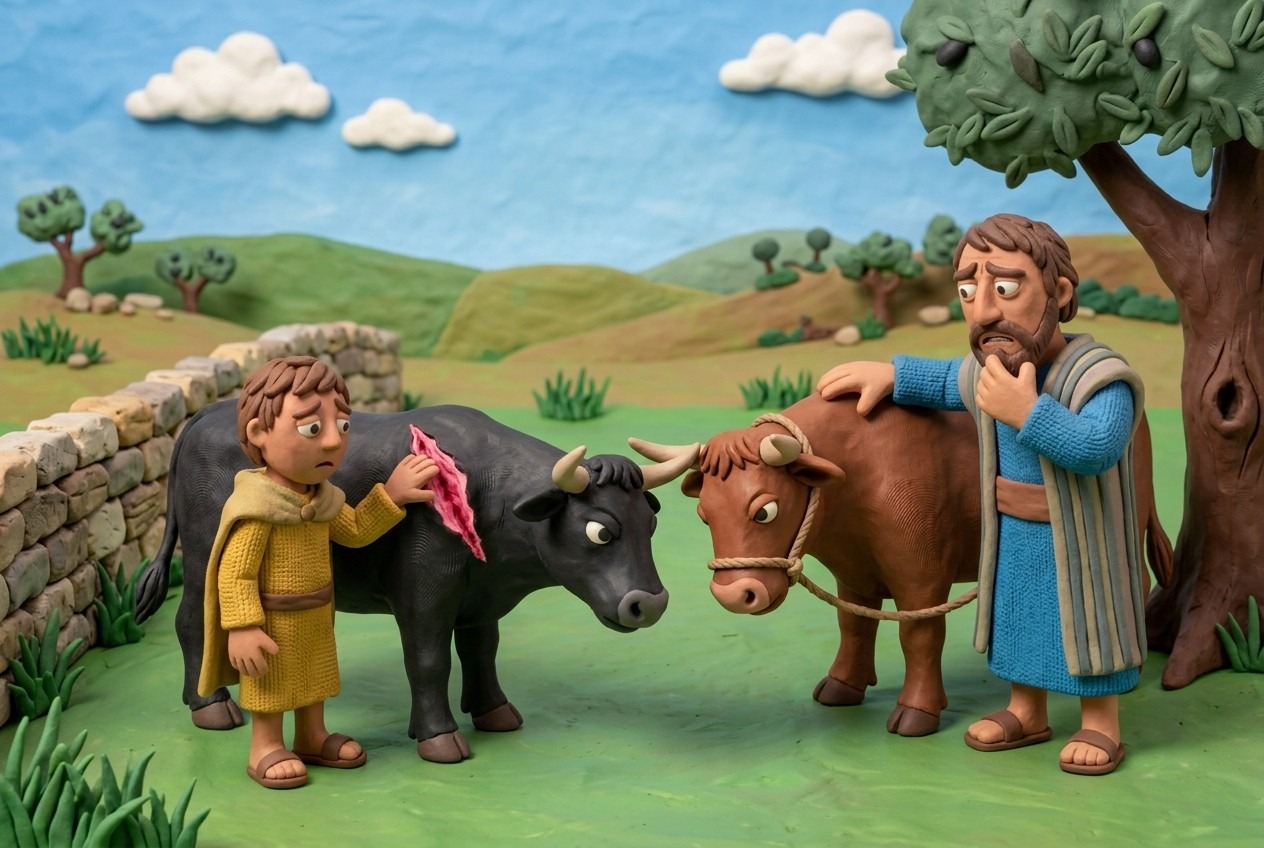
 pays?
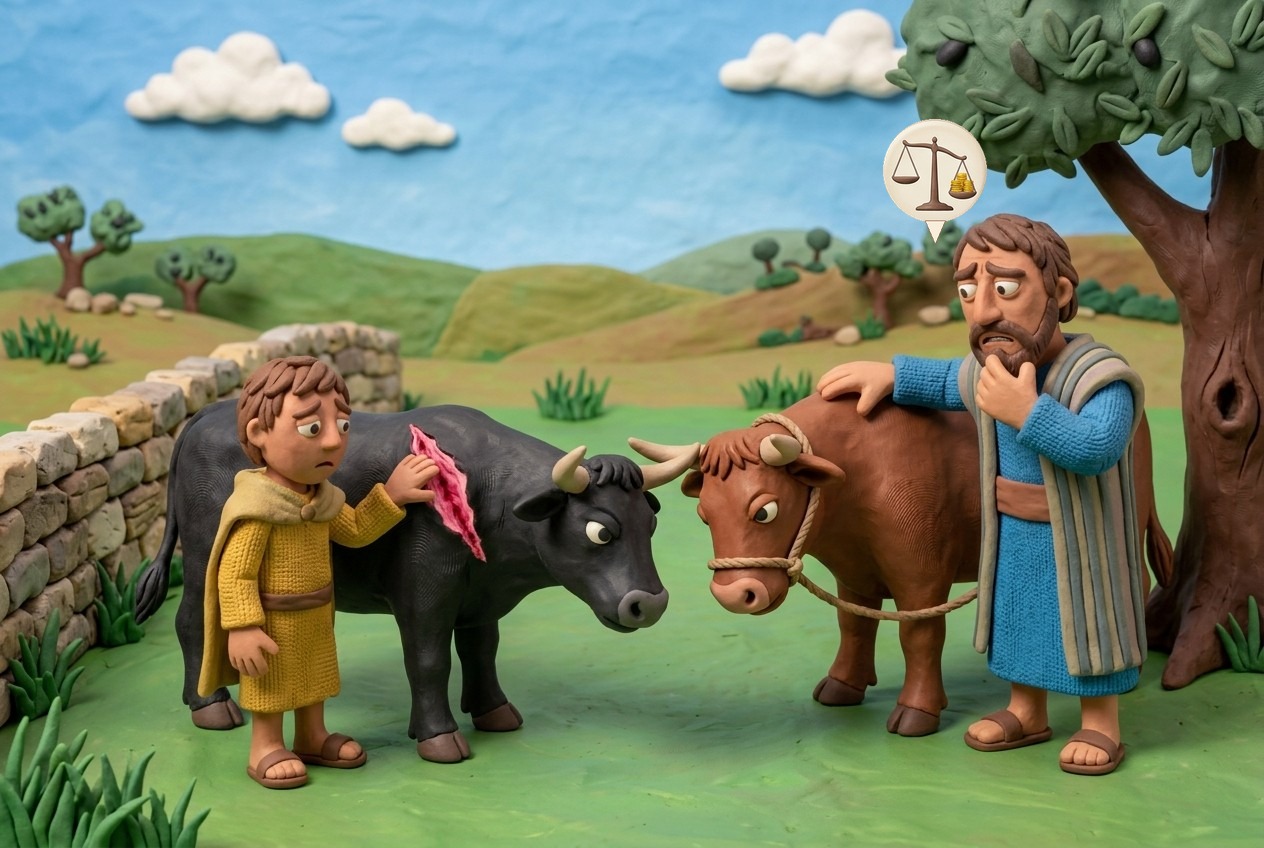 pays?
Mishnah 5: An ox that kills a person
An ox that kills a person is stoned. An attested danger's owner also pays ransom; a tam ox's owner does not. For a slave, thirty sela.
The cases
- An ox gored a person and he died: if it was an attested danger, its owner pays the ransom (kofer)the kofer (ransom); if a tam, he is exempt from it. In both cases the ox is put to death.
- The same for a son or a daughter. For a male or female slave: its owner pays 30 sela, whether the slave was worth a maneh or not a dinar.
Background
- An attested-danger ox that kills a person is stoned and its owner pays ransom (kofer)kofer (ransom) to the heirs (Exodus 21:28-30). A tam ox is stoned but its owner pays no kofer, since the Torah ordered kofer only for an attested danger.
- Kofer is the value of the person killed.
An ox that kills a person
| Victim | Tam ox | Attested danger |
|---|---|---|
| A free adult, a son or a daughter | ox stoned; no ransom | ox stoned; owner pays ransom |
| A slave or maidservant | ox stoned; owner pays 30 sela | ox stoned; owner pays 30 sela |
שור שנגח את האדם ומת. מועד משלם כופר. ותם פטור מן הכופר. וזה וזה חייבים מיתה. וכן בבן וכן בבת.
נגח עבד או אמה. נותן שלשים סלעים. בין שהוא יפה מנה ובין שאינו יפה אלא דינר אחד:
An ox that gored a person and the person died—if it was an attested danger (mu'ad)a mu'ad (attested danger), he pays ransom; if an unattested danger (tam)a tam (unattested danger), he is exempt from the ransom. But both this and that are liable to death. And the same applies to a boy and the same applies to a girl.
If it gored a slave or a maidservant, he gives thirty sela, whether the slave was worth a maneh or worth only one dinar.
Mishnah 6: An ox that did not intend to kill
An ox is judged by its intention. If it did not mean to kill a person, it is exempt from death.
The cases
- An ox rubbing against a wall that fell on a person; an ox that intended to kill an animal and killed a man; one that intended to kill a gentile and killed an Israelite; one that intended to kill an untimely birth and killed a viable infant: exempt from death.
- In each case the ox did not intend to kill a person whose killing carries death, so it is not put to death.
The ox's intention
| The ox | Result |
|---|---|
| rubbed against a wall that fell on a person | exempt from death |
| intended to kill an animal and killed a man | exempt from death |
| intended to kill a gentile and killed an Israelite | exempt from death |
| intended to kill an untimely birth and killed a viable infant | exempt from death |
שור שהיה מתחכך בכותל ונפל על האדם. נתכוין להרוג את הבהמה והרג את האדם. לעובד כוכבים והרג בן ישראל. לנפלים והרג בן קיימא פטור:
If an ox was rubbing against a wall and it fell on a person; or if it intended to kill an animal but killed a person; or intended to kill a gentile but killed a Jew; or intended to kill a non-viable baby but killed a viable person—it is exempt.
Mishnah 7: Oxen of those with no adult male owner
The ox of a woman, orphans, a guardian, or a wild, Temple or convert's ownerless ox that kills is put to death. Rabbi Judah exempts the ones with no owner. The halakha does not follow him.
The list
- The ox of a woman, of orphans, of a guardian, a wild ox, an ox of the Temple, or of a convert who died without heirs: all are liable to death.
- Rabbi Judah: a wild ox, a Temple ox and a convert's ox are exempt, since they have no owners.
- Rabbi Judah looks at the time of judgment: if the ox then has no owner it is exempt, even if it gored while it had one.
Halakha
- The halakha does not follow Rabbi Judah.
שור האשה. שור היתומים שור האפוטרופוס. שור המדבר. שור ההקדש. שור הגר שמת ואין לו יורשים הרי אלו חייבים מיתה.
רבי יהודה אומר שור המדבר שור ההקדש שור הגר שמת פטורים מן המיתה. לפי שאין להם בעלים:
An ox belonging to a woman, an ox belonging to orphans, an ox in the custody of a steward, a desert ox, a consecrated ox, an ox belonging to a convert who died and has no heirs—all of these are liable to death.
Rabbi Yehuda says: A desert ox, a consecrated ox, and an ox belonging to a convert who died are exempt from death, since they have no owners.
Mishnah 8: Dedicating an ox that is going to be stoned
An owner cannot dedicate or slaughter an ox once sentence is complete. Before that, his act is valid.
After the sentence
- If an ox goes out to be stoned and its owners dedicate it, it is not dedicated. If he slaughtered it, its flesh is forbidden.
Before the sentence
- If before its sentence was complete its owner dedicated it, it is dedicated; if he slaughtered it, its flesh is permitted.
- The mishnah teaches from when the owners lose their power over an ox that killed: once its sentence is complete they have no right to dedicate it.
Kehati's notes
- After the sentence the flesh is forbidden to eat and to benefit from.
An ox sentenced to stoning
| Dedicated to the Temple | Slaughtered | |
|---|---|---|
| After the sentence is complete | not dedicated | flesh forbidden |
| Before the sentence is complete | dedicated | flesh permitted |
שור שהוא יוצא להסקל והקדישו בעליו אינו מוקדש. שחטו. בשרו אסור.
ואם עד שלא נגמר דינו הקדישו בעליו מוקדש. ואם שחטו. בשרו מותר:
An ox that is going out to be stoned, and its owner consecrated it—it is not consecrated. If he slaughtered it, its flesh is forbidden.
But if its owner consecrated it before its verdict was finalized, it is consecrated, and if he slaughtered it, its flesh is permitted.
Mishnah 9: Guards, and an ox that was properly guarded
A guard takes the owner's place. If the owner tied or locked the ox properly and it still damaged, the sages dispute: Rabbi Meir, Rabbi Judah and Rabbi Eliezer. The halakha follows Rabbi Judah.
A guard takes the owner's place
- If one handed it to an unpaid guardian, a borrower, a paid guardian or a hirer, they take the place of the owners: full damages for an attested danger, half for a tam.
An ox properly guarded
- If its owner tied it with a halter or locked it up properly, but it came out and caused damage: Rabbi Meir: liable, whether an an attested danger or a tam.
- Rabbi Judah: if a tam he is liable; if an attested danger he is exempt, as it says "and its owner did not guard it", but this one was guarded.
- Rabbi Eliezer: its only guarding is the knife.
Kehati's notes
- Rabbi Judah's exemption is from the full payment: the owner still pays half damages.
- There are three views about an attested danger that was guarded: Rabbi Meir: liable if the guard was weak, exempt if strong; Rabbi Judah: exempt from the full payment even with a weak guard; Rabbi Eliezer: liable even with a strong guard.
Halakha
- The halakha follows Rabbi Judah.
A tied or locked ox that got out and damaged
| Rabbi Meir | Rabbi Judah | Rabbi Eliezer |
|---|---|---|
| liable, a tam or an attested danger | tam: liable; attested danger: exempt | its only guarding is the knife |
מסרו לשומר חנם. ולשואל. לנושא שכר. ולשוכר. נכנסו תחת הבעלים. מועד משלם נזק שלם ותם משלם חצי נזק.
קשרו בעליו במוסרה ונעל בפניו כראוי. ויצא והזיק. אחד תם ואחד מועד חייב. דברי רבי מאיר.
רבי יהודה אומר תם חייב. ומועד פטור. שנאמר (שמות כא, לו) ולא ישמרנו בעליו ושמור הוא זה.
רבי אליעזר אומר אין לו שמירה אלא סכין:
If the owner conveyed it to an unpaid bailee, or to a borrower, or to a paid bailee, or to a renter, they enter in place of the owner: if it was an attested danger (mu'ad)a mu'ad (attested danger), he pays full damage, and if an unattested danger (tam)a tam (unattested danger), he pays half the damage.
If its owner tied it with reins and locked the gate before it in an appropriate manner, but it emerged and caused damage, whether an unattested dangera tam or an attested dangera mu'ad, he is liable; this is the statement of Rabbi Meir.
Rabbi Yehuda says: If an unattested dangera tam, he is liable; if an attested dangera mu'ad, he is exempt, as it is stated: "and the owner has not secured it," and this one was secured.
Rabbi Eliezer says: It has no sufficient safeguarding other than a knife.
Chapter summary
Draft for review. The outlines are in our own words.
Key principles
- An ox that is an unattested danger (tam)a tam (unattested danger) pays only from its own body; the injured owner is either a new owner or a partner in it (Rabbi Meir and Rabbi Shimon). 4:1
- An ox can be an attested danger (mu'ad)a mu'ad (attested danger) for one kind of victim or one day, and unattested danger (tam)tam (unattested danger) for others: full damages for the one, half for the other. 4:2
- An Israelite's ox is exempt for damage to Temple property and to a gentile's ox; a gentile's ox pays full damages to an Israelite. 4:3
- An ox that kills a person is stoned; the owner of an attested danger (mu'ad)a mu'ad (attested danger) pays ransom (kofer)kofer (ransom), the owner of an unattested danger (tam)a tam (unattested danger) does not. 4:5
- An ox is judged by its intention: it is exempt from death if it did not intend to kill a person. 4:6
- A guard takes the owner's place; an owner who tied or locked his ox properly: the sages dispute, and the halakha follows Rabbi Judah. 4:9
Key terms
kofer (ransom) כופר 4:5
The payment an owner of an attested danger makes to ransom his life when his ox kills a person. It is the value of the person killed.
apotropos (guardian) אפוטרופוס 4:4
A person the court appoints to watch the ox of a deaf-mute, person with psychosis or minor.
paid guardian, borrower, hirer שומר שכר, שואל, שוכר 4:9
People to whom an ox is handed; they take the owner's place for its damage.
Key debates
What does the injured owner become? 4:1
A creditor, paid first from the last victim backward.
A partner in the ox, so the victims share.
Is the ox a tam again when its owner recovers? 4:4
A tam again.
It remains as it was.
A properly guarded ox that still damages 4:9
Rabbi Meir: liable, whether a tam or not. Rabbi Judah: a tam, liable; attested danger, exempt from the full payment.
Its only guarding is the knife. The halakha follows Rabbi Judah.