 keeps it
  has no claim
  returns it
  does not return it
  holds it
  follows the simpon (the attached note)
Mishnah 1: Two people grip a cloak
When two people each claim a cloak and neither can prove it, each swears and they divide it by what each claims.
The case
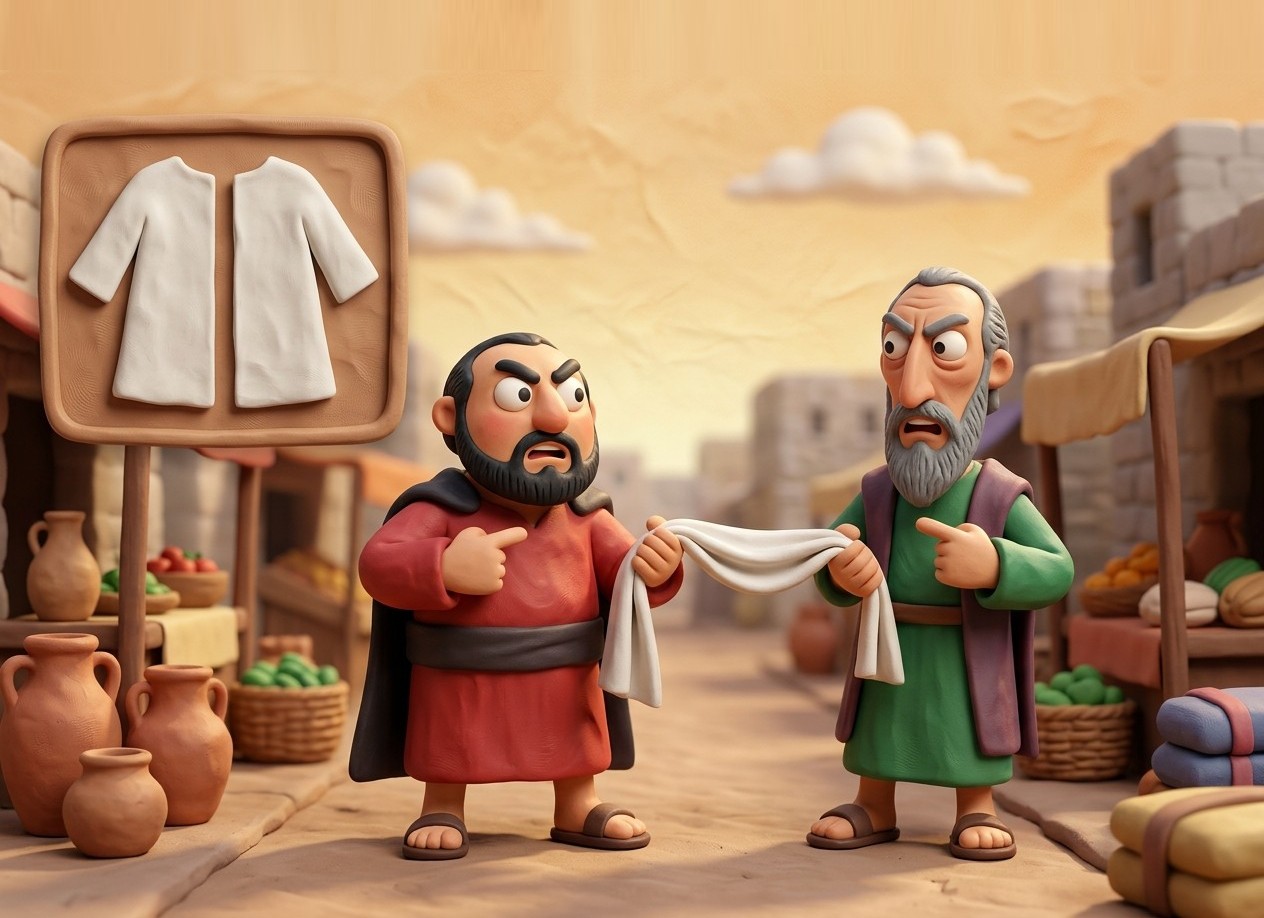
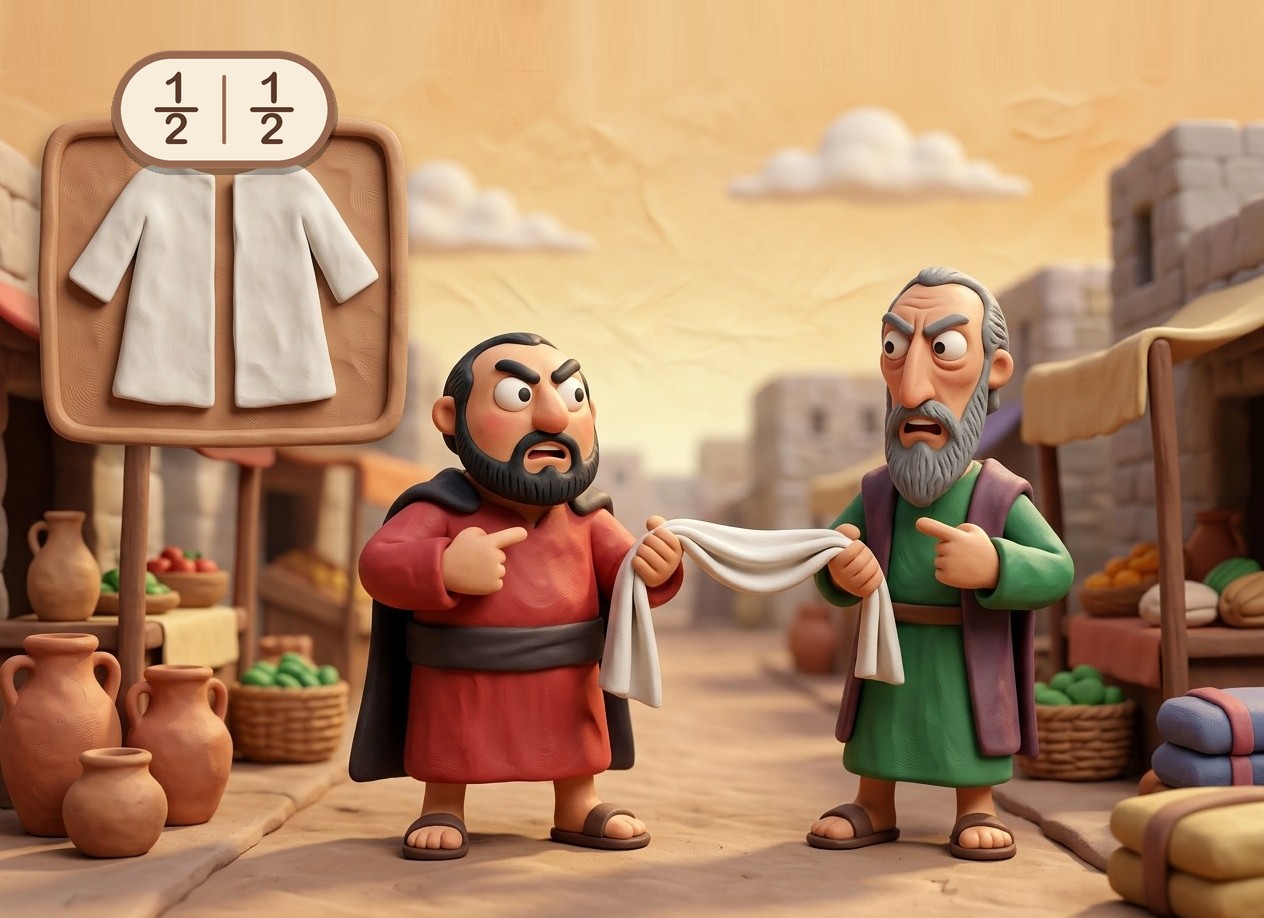
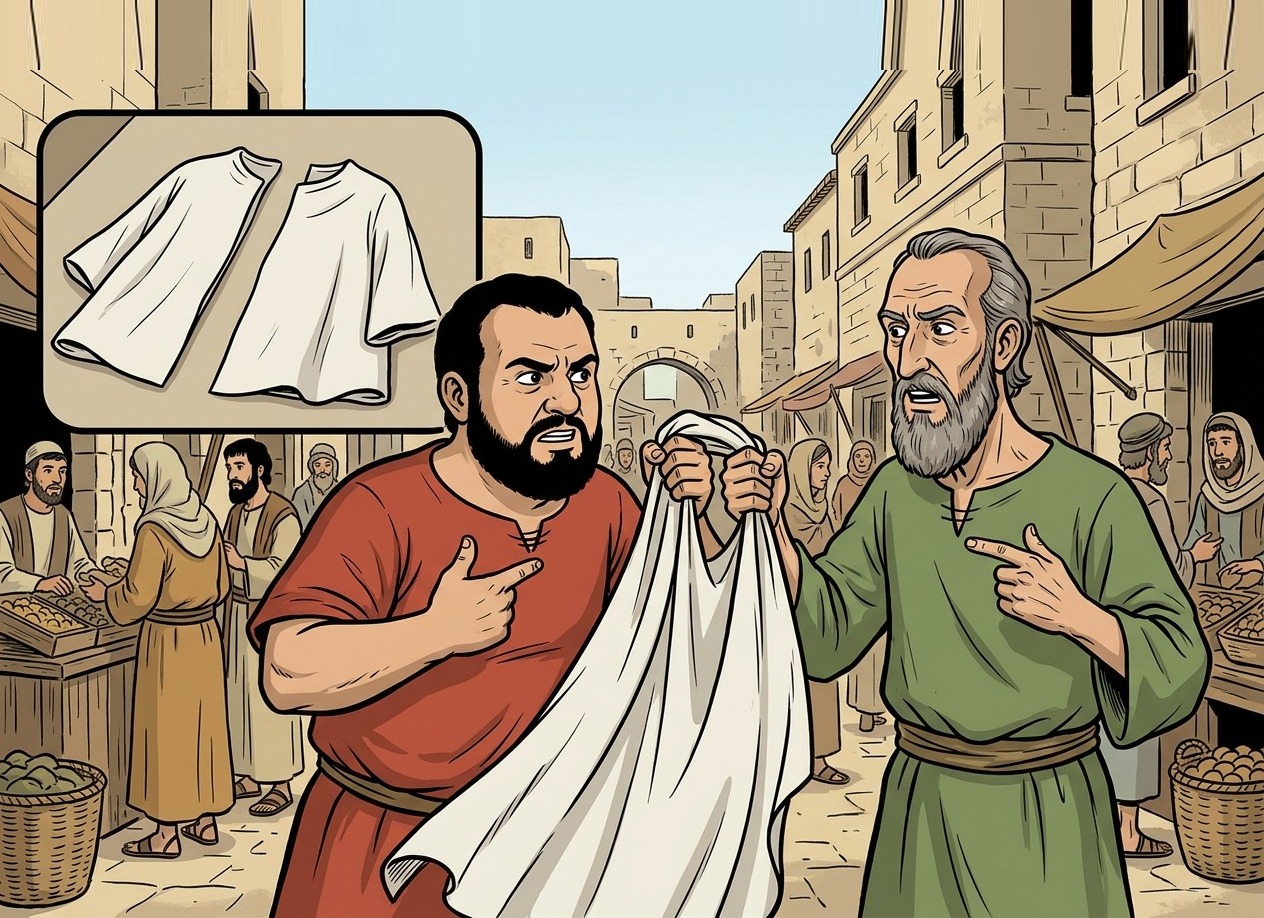
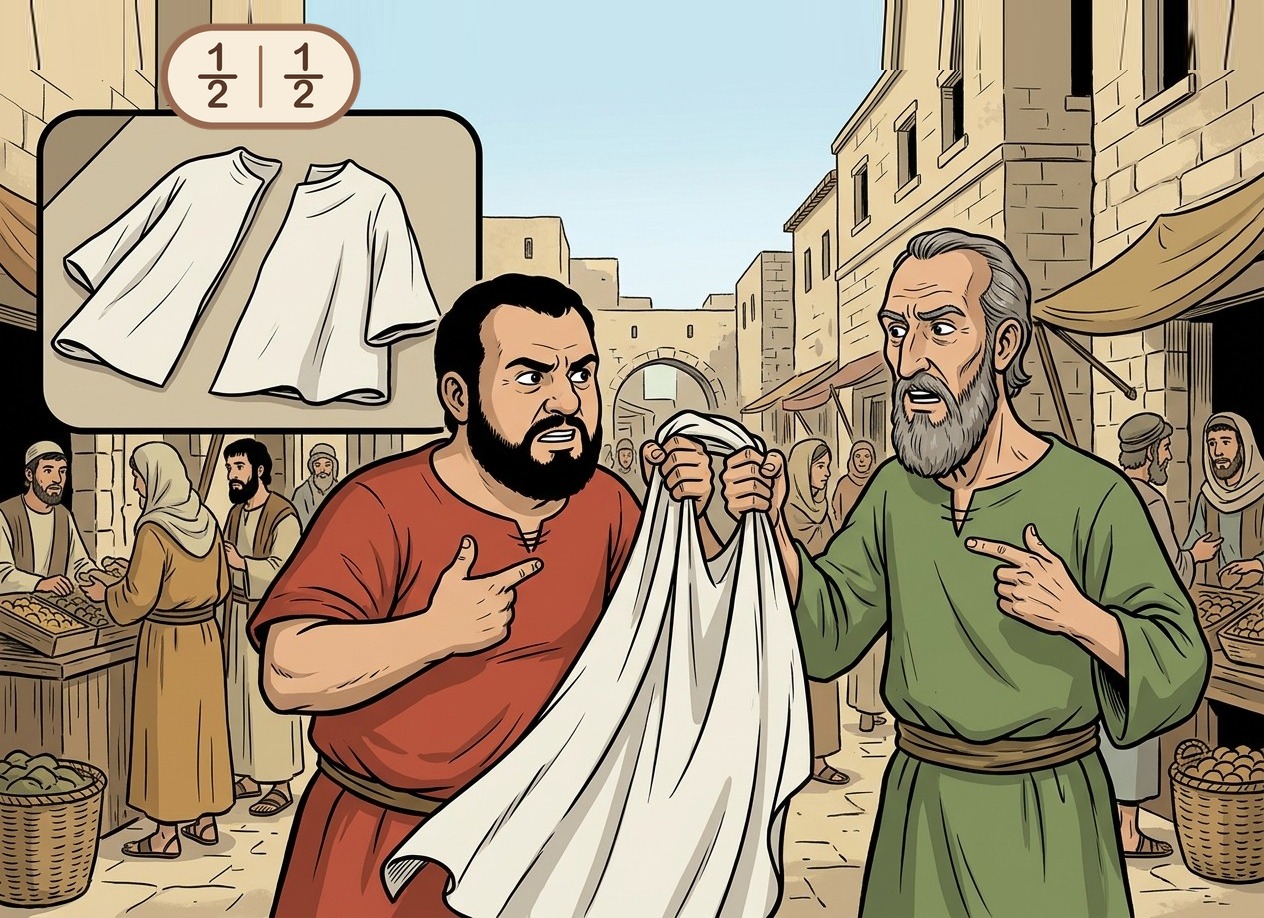
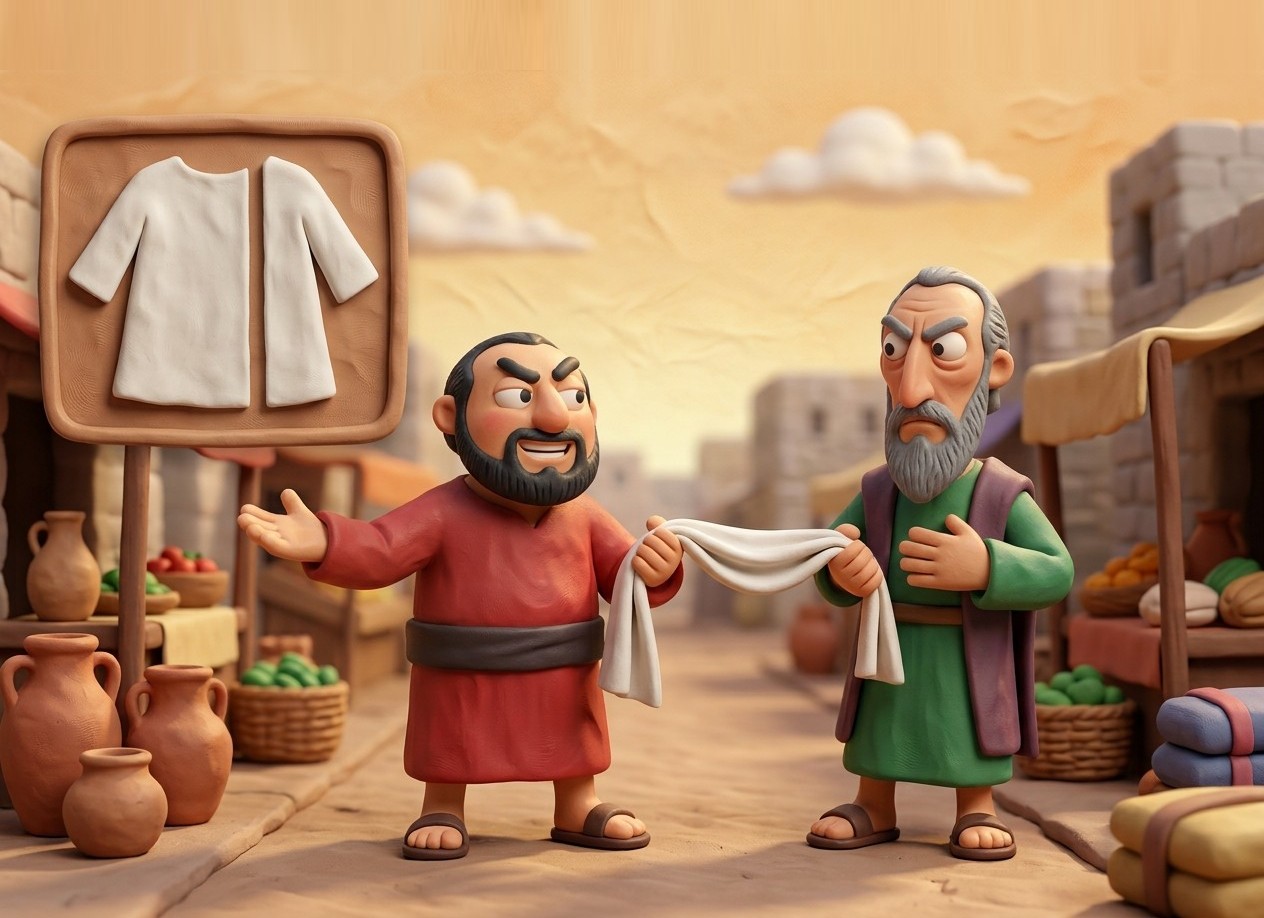
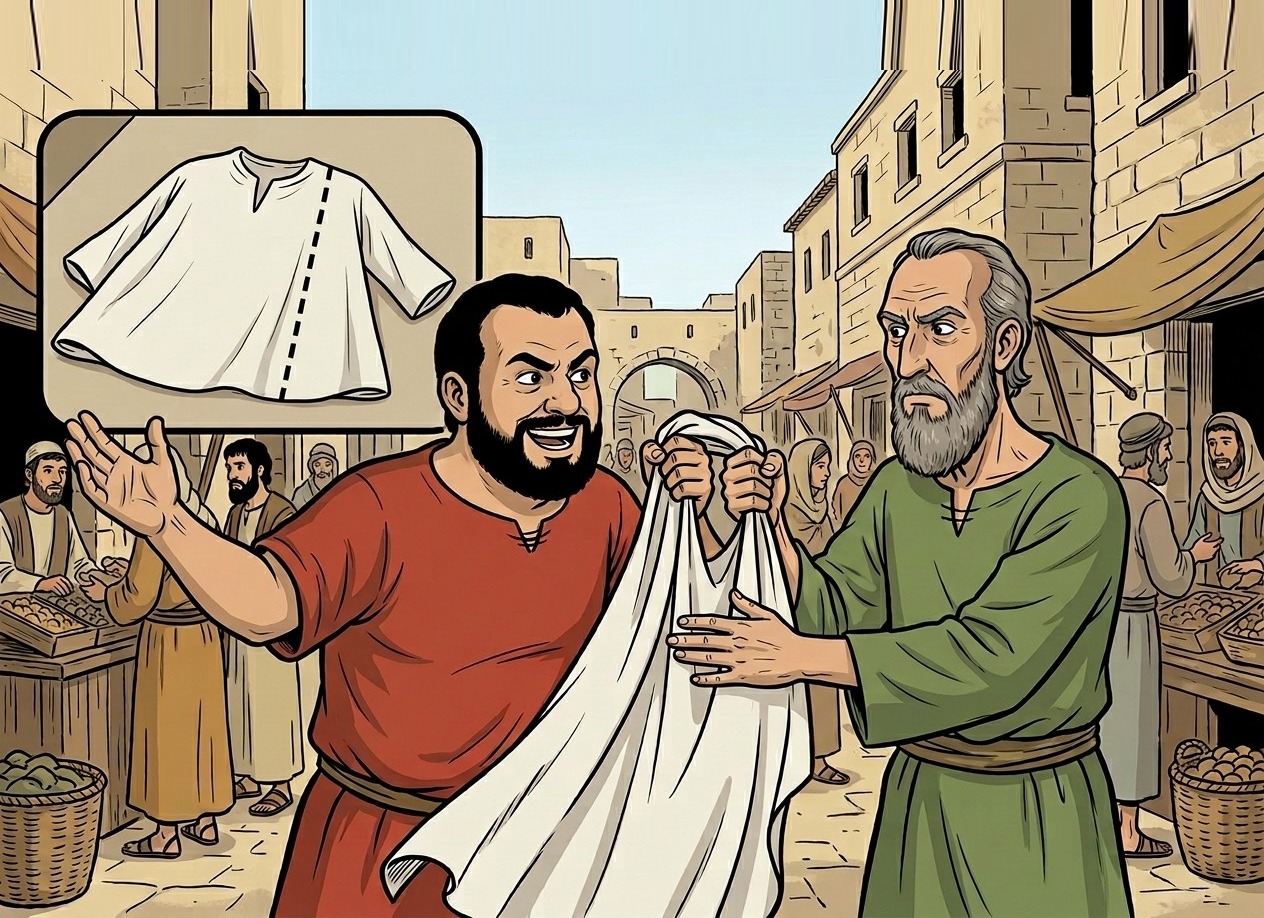
- Two people are grasping a cloak, each saying "I found it" or "it's all mine," and neither can prove it. With no witnesses, the judges rely on an oath.
- Oaths were taken very seriously, so an oath is a strong deterrent to lying.
Both claim all of it
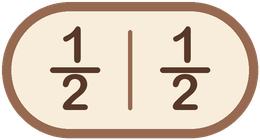
- Each swears that he owns no less than half of the cloak, and they split it.
One claims all, the other claims half
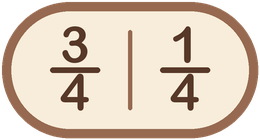
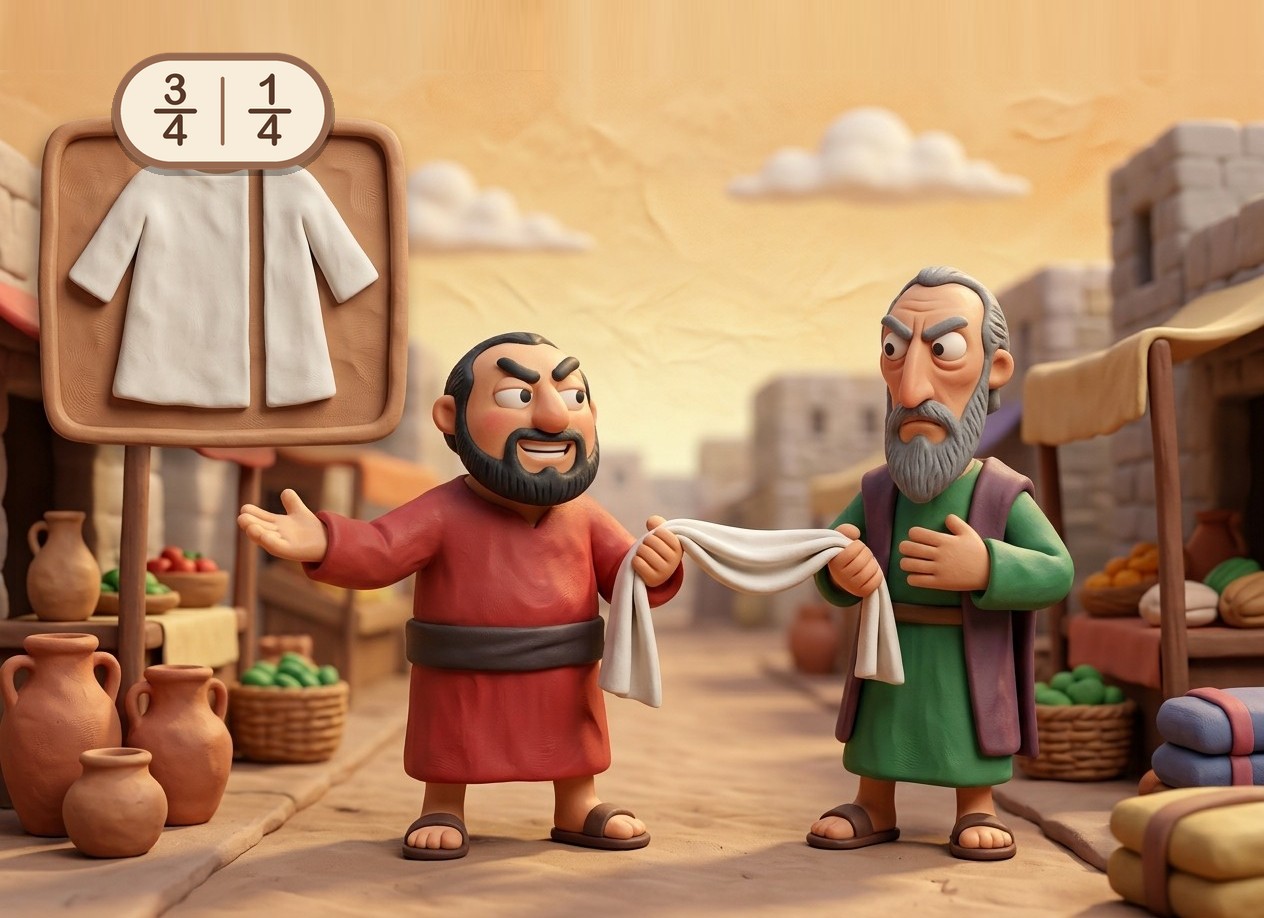
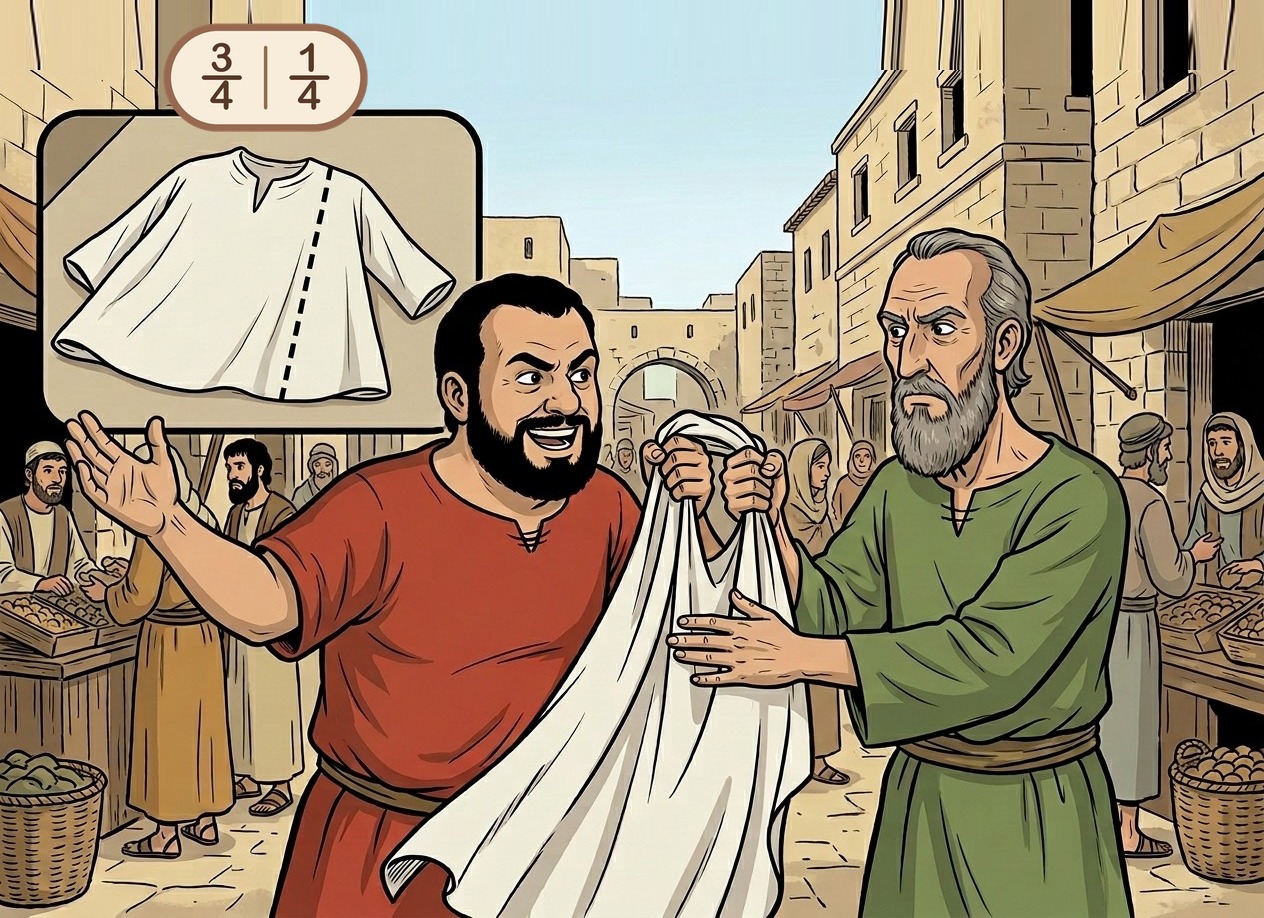
- The one who says "it's all mine" swears that he owns no less than three quarters; the one who says "half is mine" swears that he owns no less than a quarter.
- The first takes three quarters and the second takes a quarter.
How the cloak is divided
| What each claims | Each swears | They divide it |
|---|---|---|
| Both say all of it | no less than half | half and half |
| One says all, the other says half | three quarters / a quarter | three quarters and a quarter |
 ?
?
 ?
?
 ?
?
 ?
?
R. Kulp's commentary
Mishnah One 1) If two people are grasping a cloak: One says, “I found it” and the other says, “I found it”, or one says “It’s all mine”, and the other says, “It’s all mine”, they each swear that they don’t own more than half of the cloak and they split the cloak. 2) (If) one says, “It’s all mine” and the other says, “It’s half mine”, the one who says, “It’s all mine” swears that he doesn’t own less than ¾ and the one who says “It’s half mine” swears that he doesn’t own less than half, and the former takes ¾ and the latter takes ¼.
Explanation—Mishnah One This Mishnah describes the common situation in which two people claim ownership of an article and neither can prove that it belongs to him. If they were to bring witnesses the judges would rule according to their testimony. In the absence of witnesses the judges must rule based on other assumptions. The means of ensuring that the person was telling the truth was in many cases, including this one, an oath. One should note that oaths were taken extremely seriously by Jews in ancient times and the assumption is that one would not swear falsely. Therefore taking an oath is a strong deterrent to lying. Mishnah Two 1) If two men were riding on an animal, or one was riding and the other was leading the animal, and one of them said, “The animal is all mine”, and the other said “It is all mine.”, they each swear that they don’t own less than half of the animal and they split it. 2) If after the case is settled, they both admit to the others claim, or if there are witnesses they can split the animal without an oath.
Explanation—Mishnah Two This mishnah is similar to the previous mishnah and just deals with a different disputed object. In the second clause the mishnah states that if they agree to the other party’s claim or if there are witnesses that the animal is owned by both parties, they split the animal without an oath. The function of the oath is to ensure that the person is telling the truth. When there is no dispute, or when there are witnesses who testify, there is no need for an oath. Since it is preferable to avoid oaths altogether the two may split the animal without an oath.
Questions for Further Thought: • Mishnah one: When a person claims that the entire cloak is his, why does he swear that he doesn’t own less than half? What would happen if each person swore that it was all his? • Mishnah one: Why in the second clause does the person who swore that it was all his receive ¾ whereas in the first clause he receives only ½? If two people are grasping a cloak: One says, “I found it” and the other says, “I found it”, or one says “It’s all mine”, and the other says, “It’s all mine”, they each swear that they don’t own more than half of the cloak and they split the cloak. ( one says, “It’s all mine” and the other says, “It’s half mine”, the one who says, “It’s all mine” swears that he doesn’t own less than ¾ and the one who says “It’s half mine” swears that he doesn’t own less than ¼, and the former takes ¾ and the latter takes ¼. The first two mishnayoth of Bava Metzia deal with cases where two people both claim ownership over an object which they are jointly holding. This Mishnah describes the common situation in which two people claim ownership of an article and neither can prove that it belongs to him. If they were to bring witnesses the judges would rule according to their testimony. In the absence of witnesses the judges must rule based on other assumptions. The means of ensuring that the person was telling the truth was in many cases, including this one, an oath. One should note that oaths were taken extremely seriously by Jews in ancient times and the assumption is that one would not swear falsely. Therefore taking an oath is a strong deterrent to lying.
Mishnah 2: Two men and a donkey
Two men on one animal each say it is all theirs: they swear and split its value. If they agree or there are witnesses, no oath is needed.
The case
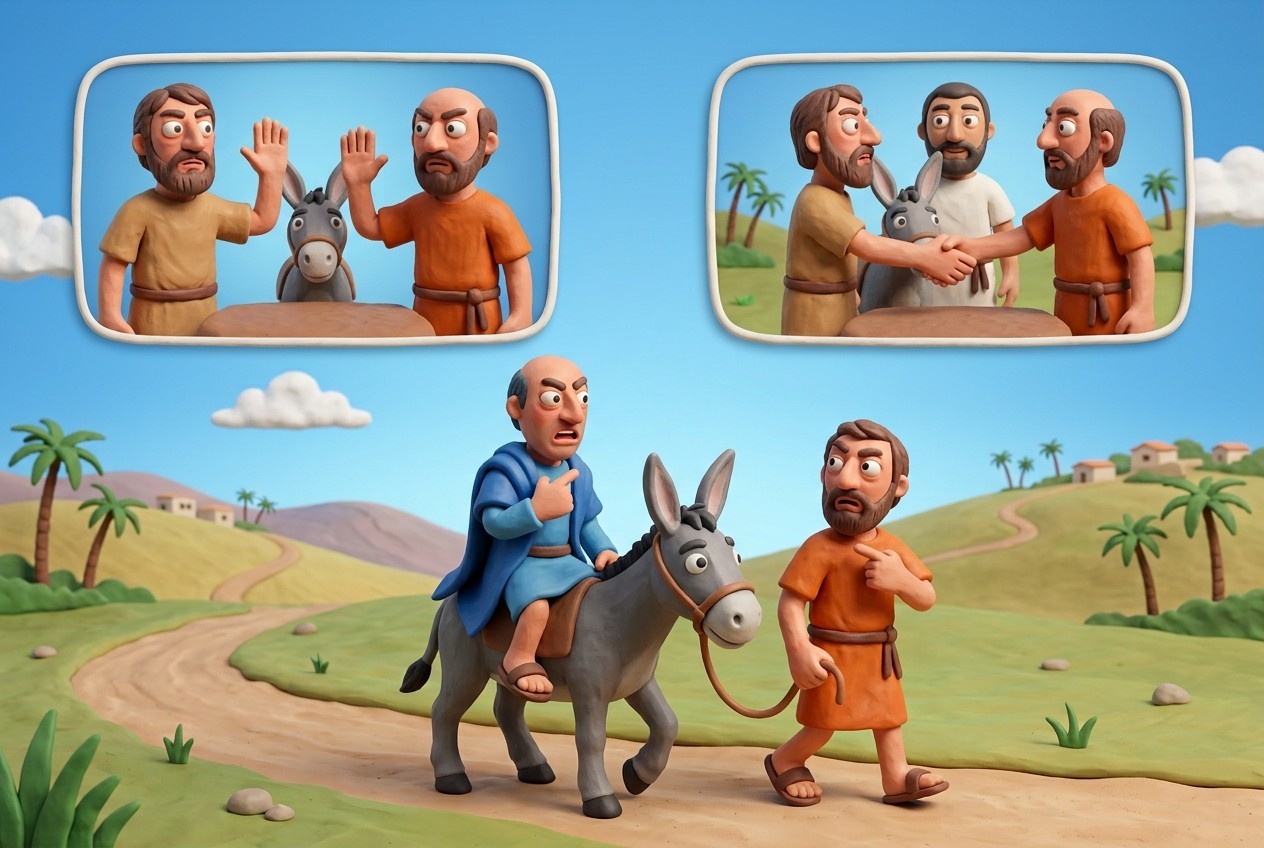
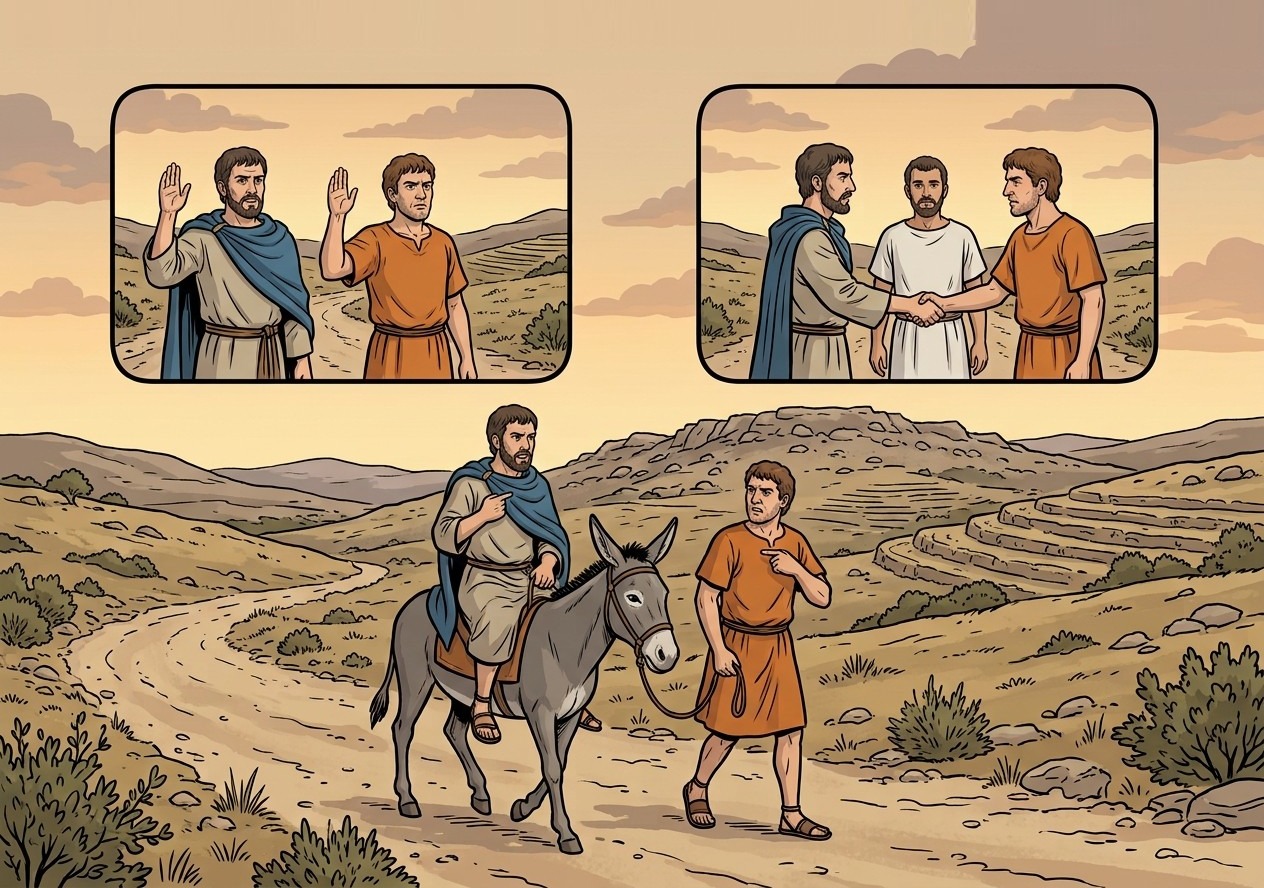
- Two men were riding on an animal, or one was riding and the other leading it. Each says it is all his.
- Each swears that he owns no less than half, and they split it.
No oath needed
- If after the case is settled they both admit the other's claim, or there are witnesses, they split the animal without an oath.
- The oath only ensures the person is telling the truth; when nobody disputes it, or witnesses testify, there is no need, and it is better to avoid oaths.
Splitting the animal
| Situation | Oath? | Result |
|---|---|---|
| Each claims all of it | Each swears | They split it |
| They later admit each other's claim, or there are witnesses | No oath | They split it |
 12
12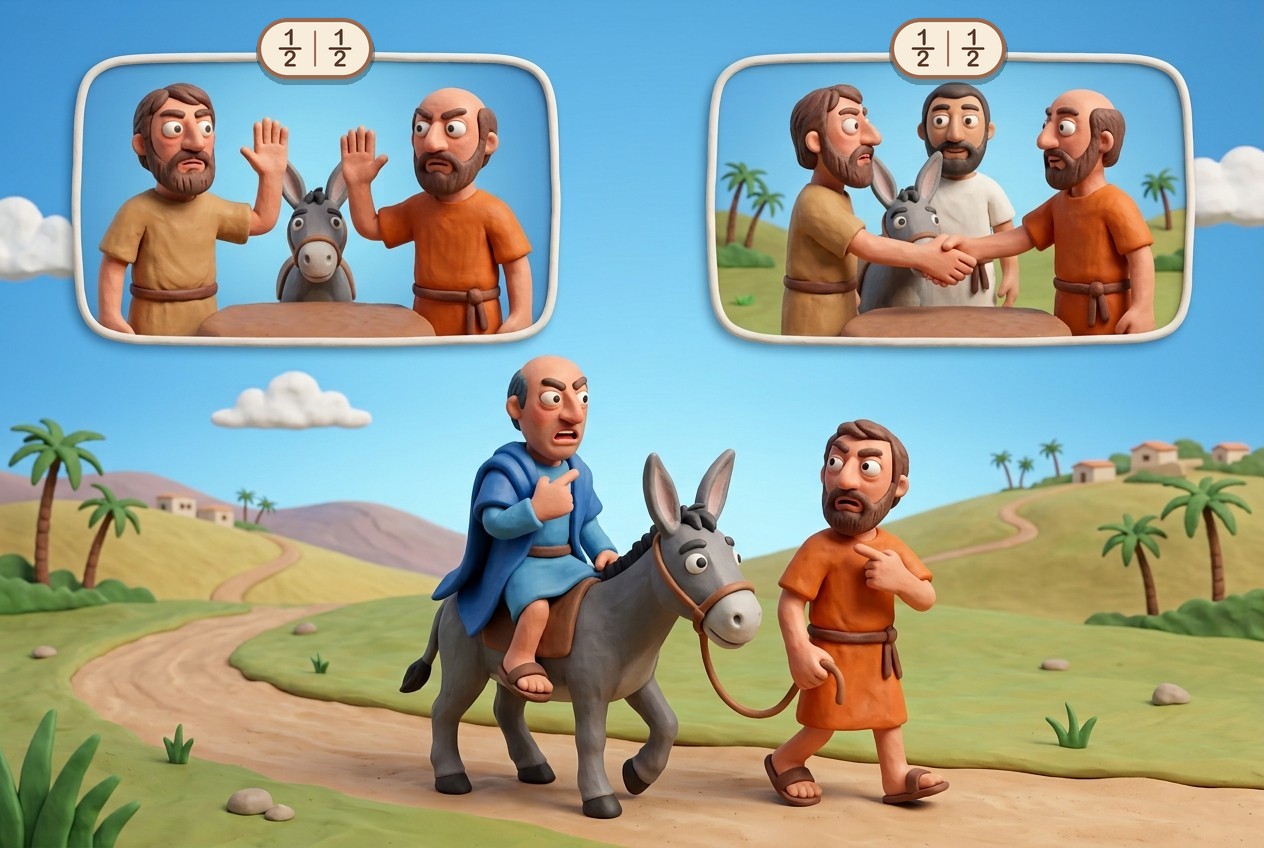
 12
12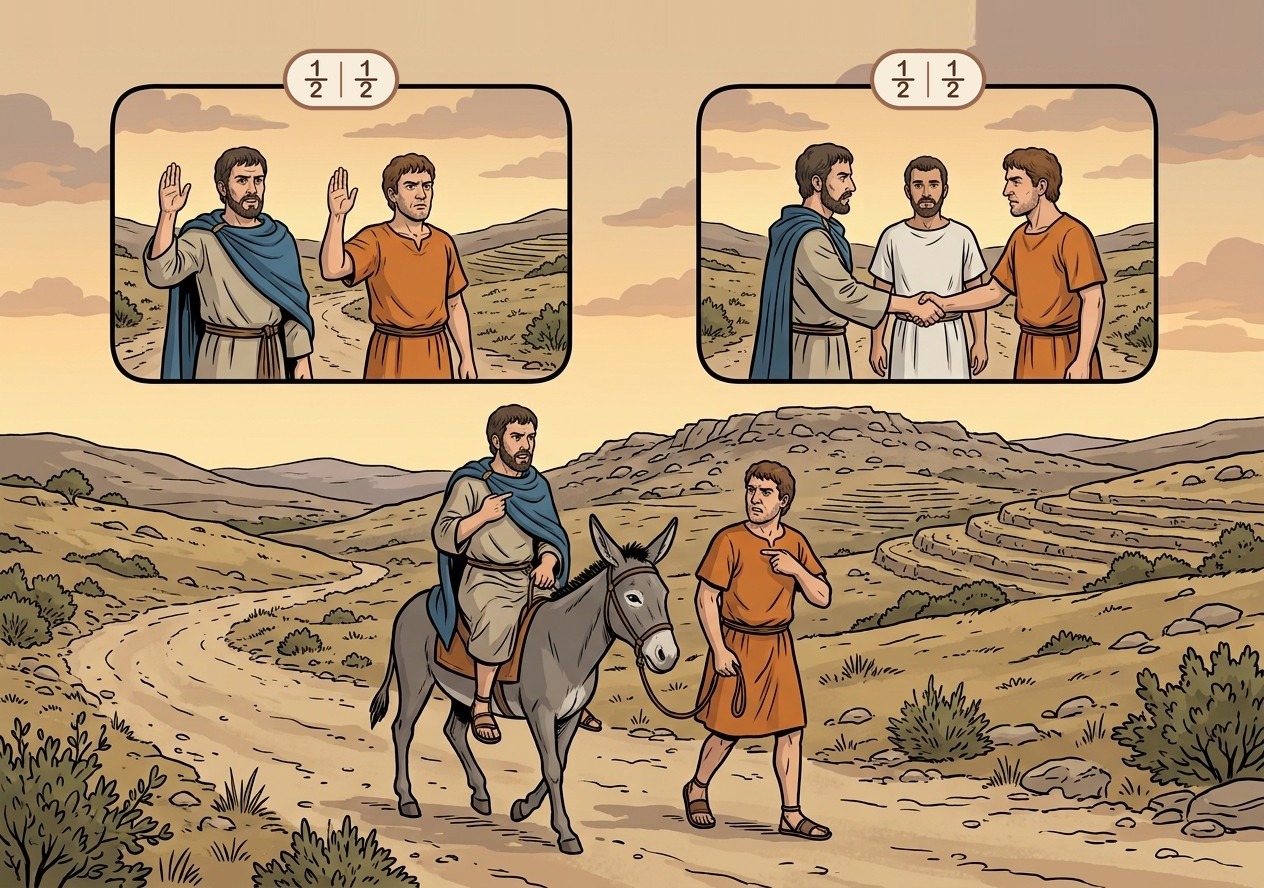
Mishnah 3: Lost property seen from a donkey
A claim of ownership has to come when you hold the object, not after you have already given it away.
Acquiring it
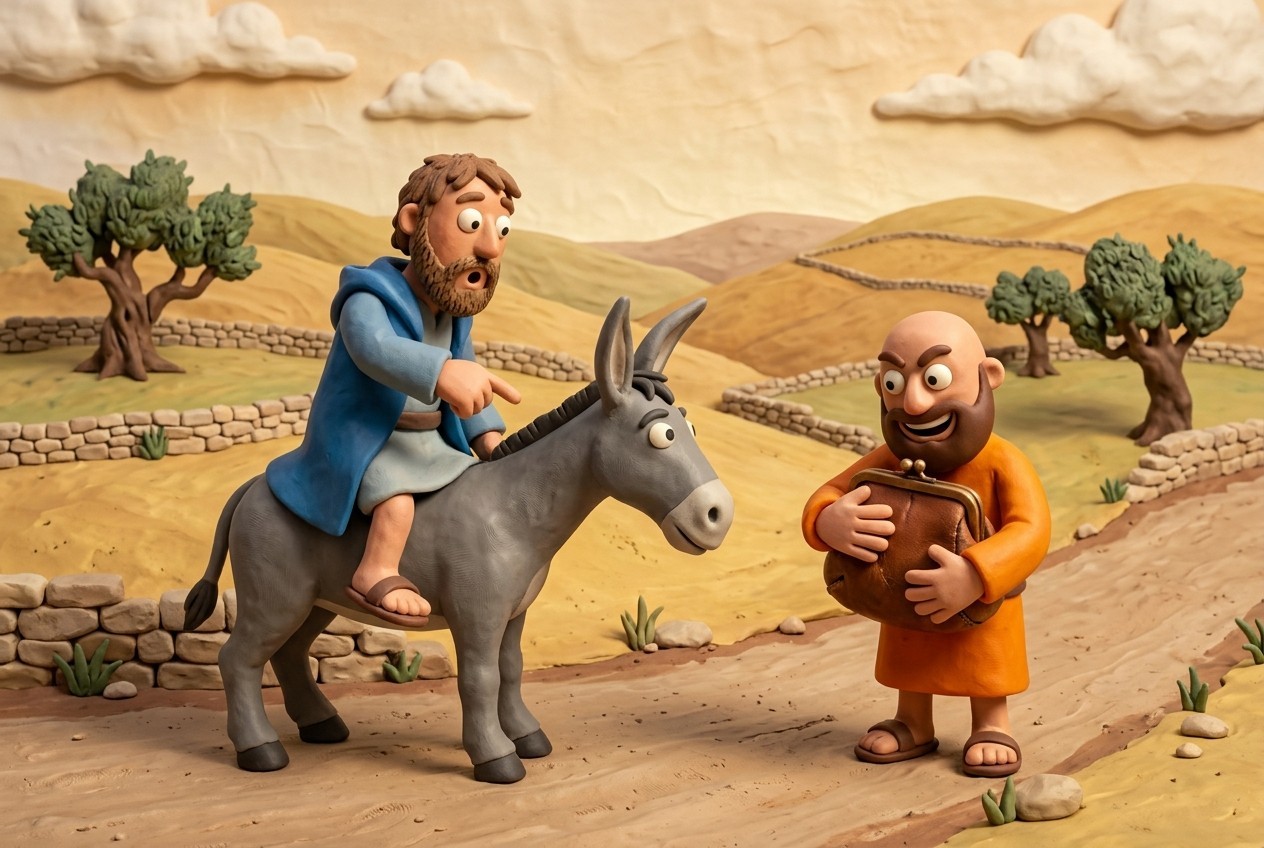
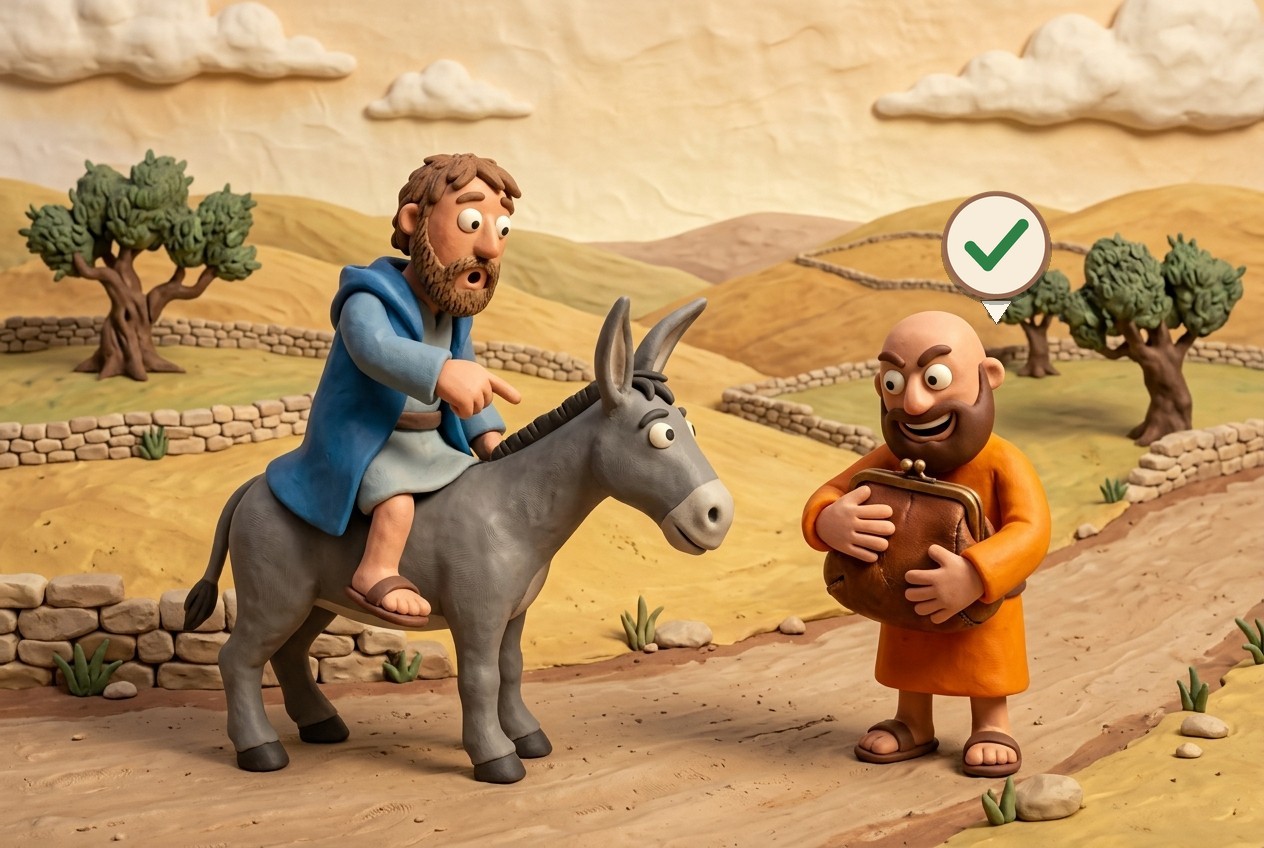
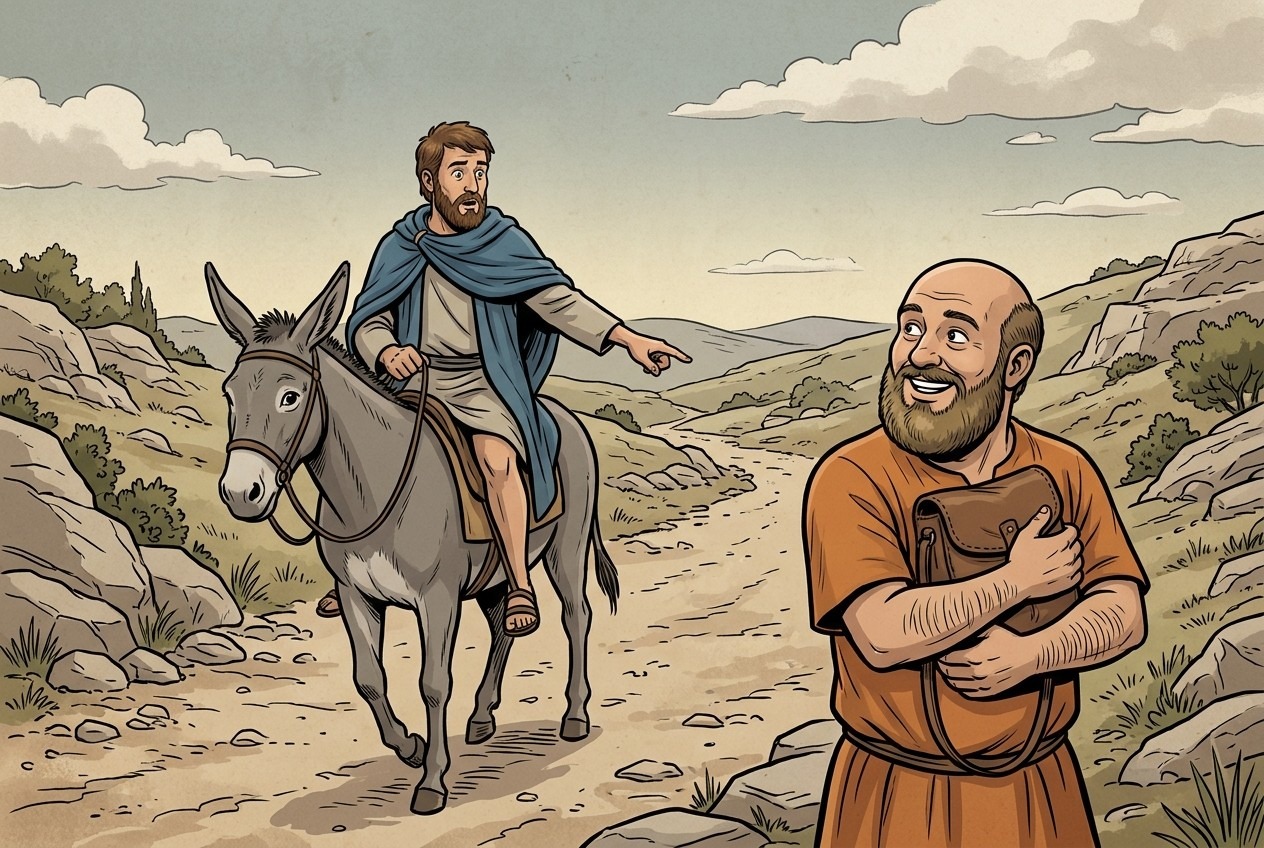
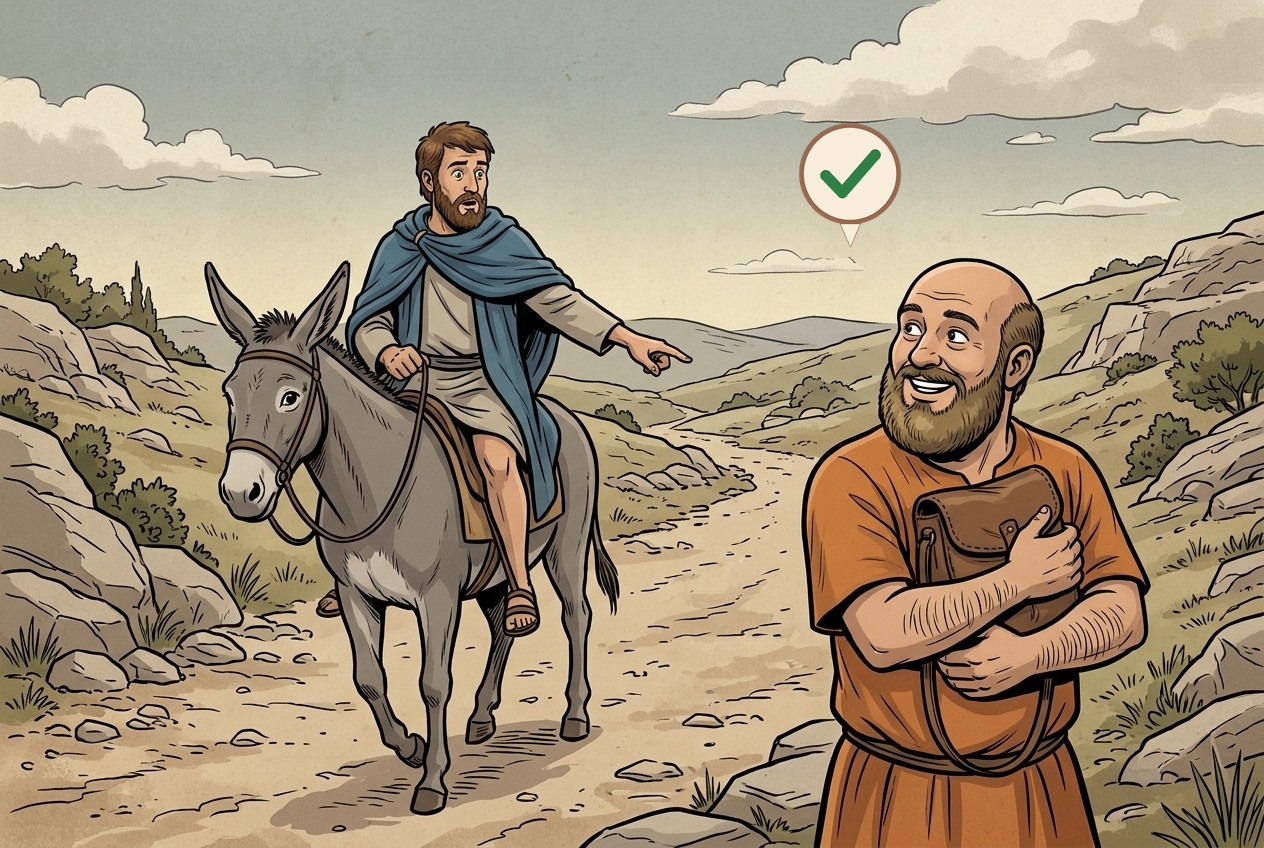
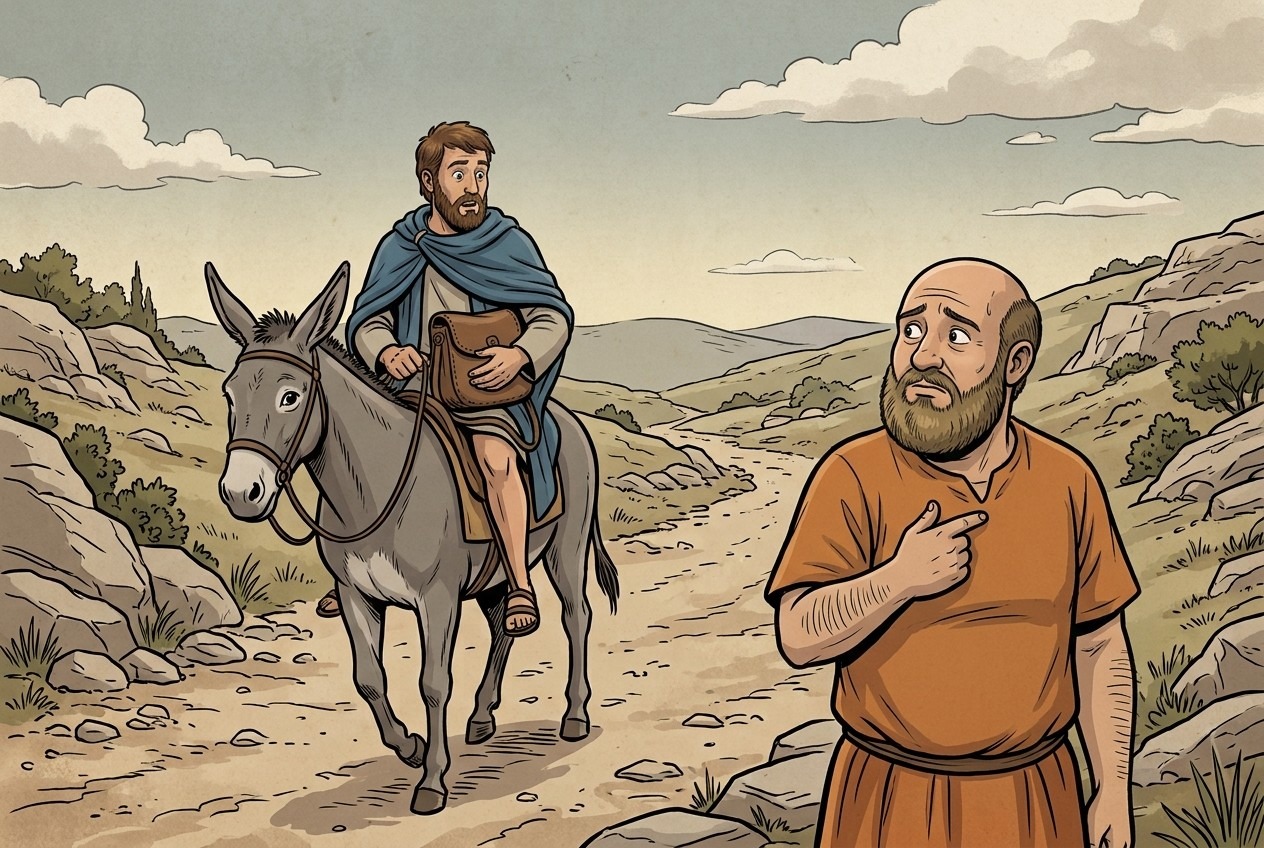
- A man was riding on a beast and saw lost property and said to his friend, "Give it to me." The friend picked it up and said "I have acquired it": he has acquired it.
Too late
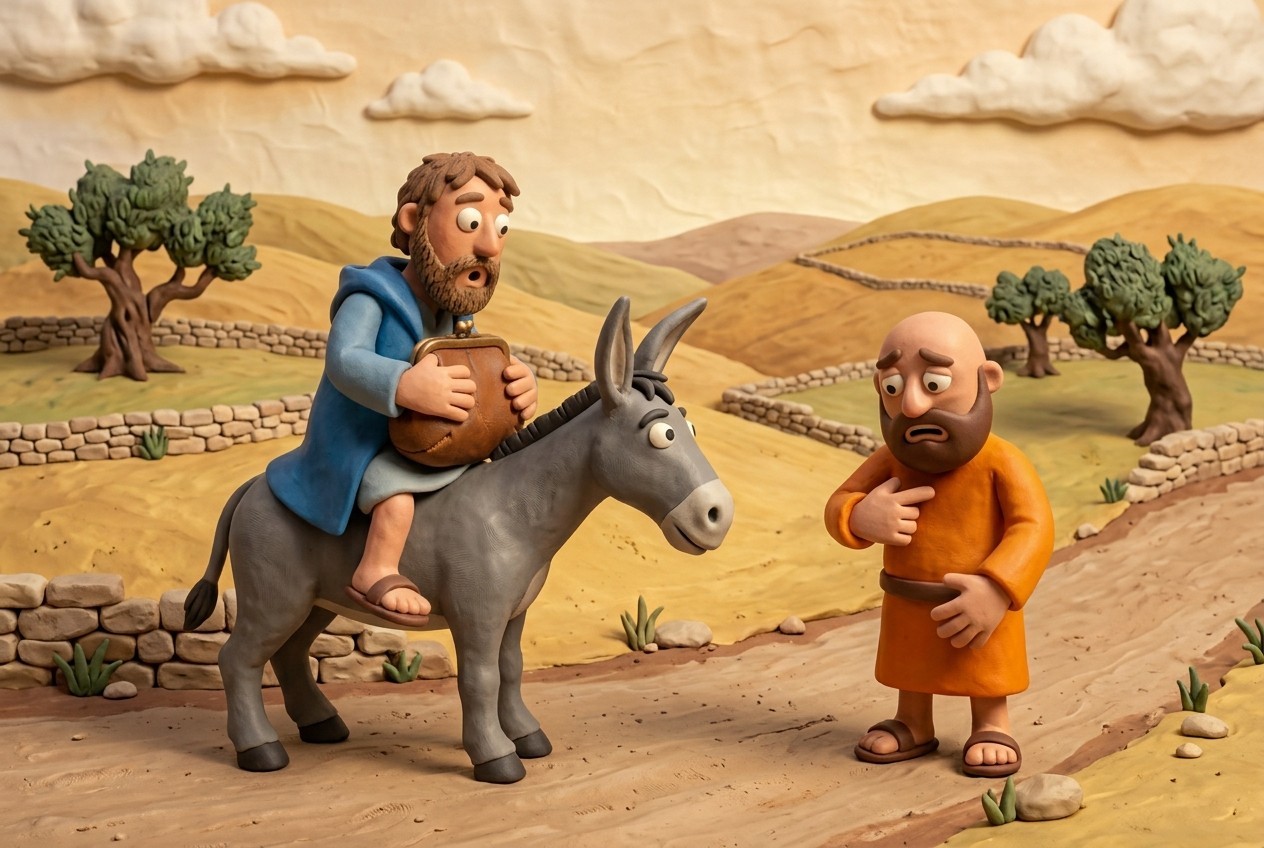
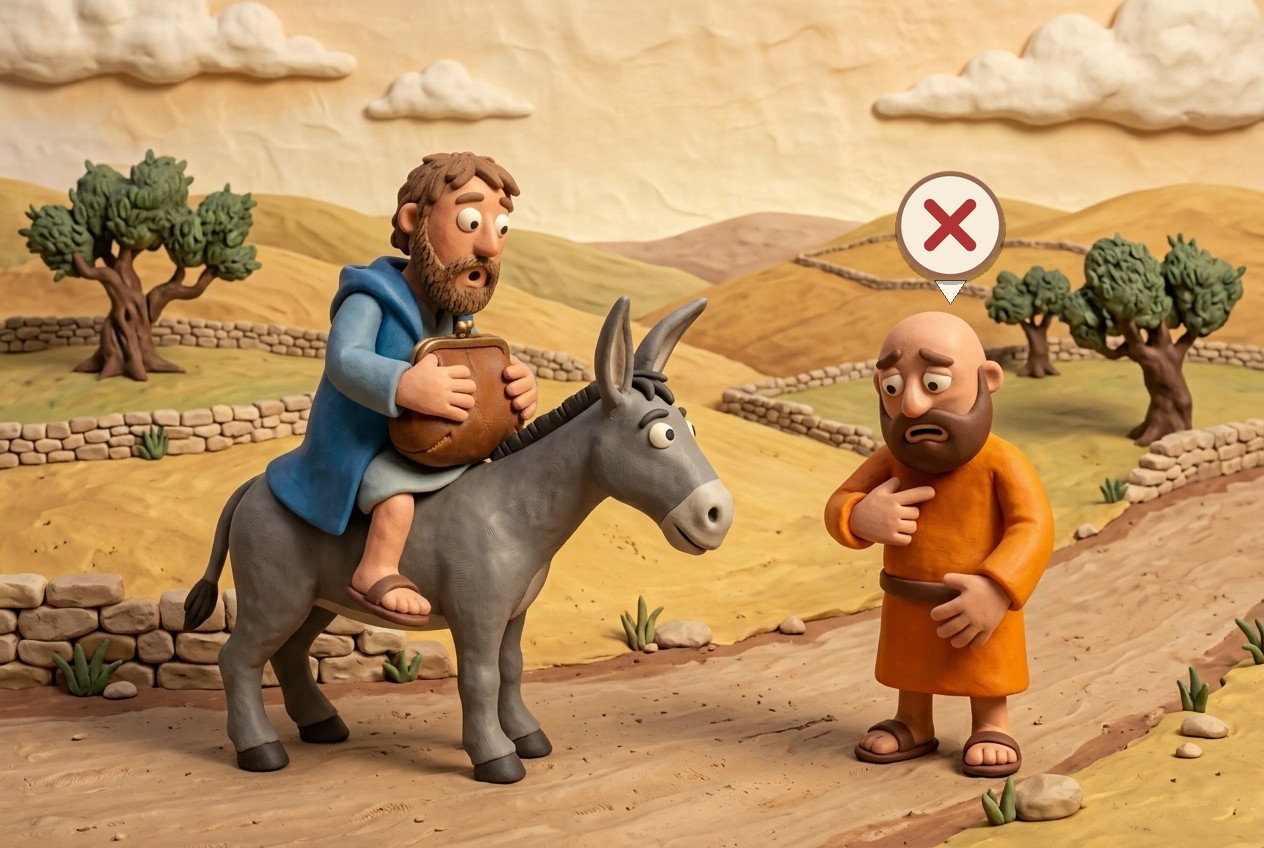
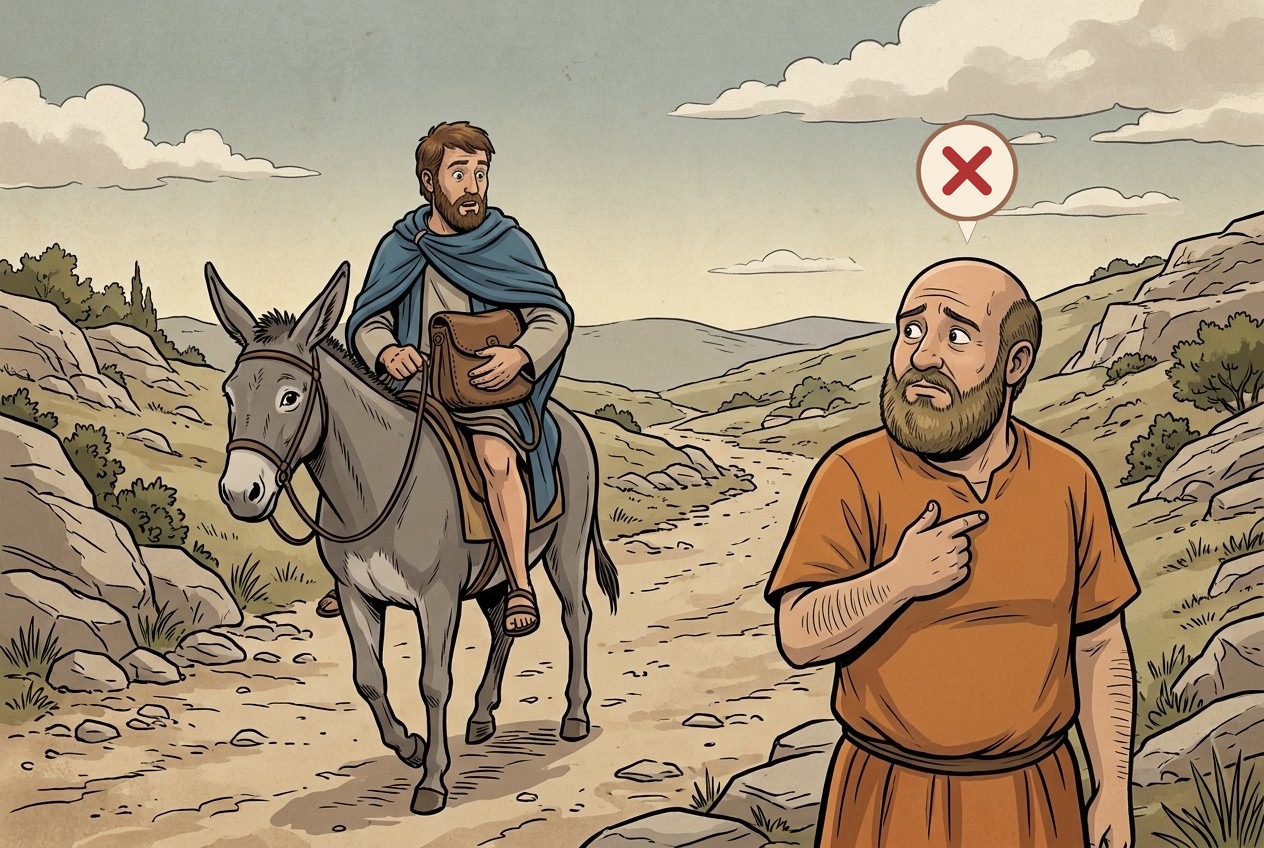
- But if he first handed it to the rider and only then said "I acquired it first," he has said nothing.
- The claim to ownership must come at the same time that he actually has possession, not after he has already given it to someone else.
Who keeps the lost object?
| What the friend does | Result |
|---|---|
| Picks it up and says "I acquired it" | He acquires it |
| Gives it to the rider, then says "I had it first" | His words mean nothing |
 ?
?
 ?
?
 ?
?
 ?
?
R. Kulp's commentary
If a man was riding on a beast and saw lost property and said to his fellow, “Give it to me”, and the other took it and said, “I have acquired it”, he (the has acquired it. But if after he gave it to him he said, “I acquired it first”, he has said nothing. In the first section of the mishnah a person saw an object while riding on an animal and told his friend to pick it up for him. When his friend picked it up he claimed it for himself. According to the mishnah the person who picked it up can claim title to the object. If, however, the person picked it up and then gave it to his fellow, he cannot subsequently claim title. The person’s claim to ownership must come at the same time that he actually has possession of the object and not after he has already given it to someone else.
Questions for Further Thought: Mishnah three: According to the mishnah by merely telling the other person to pick it up for him the person riding on the animal does not acquire the object. Why not?
Mishnah 4: Seizing lost property, and the field that acquires
Someone who falls on a lost object loses it to whoever seizes it first. A field can acquire an animal that cannot leave it.
Falling on it
- If a man saw lost property and fell upon it, and someone else came and seized it, the one who seized it acquired it.
"My field acquires it"
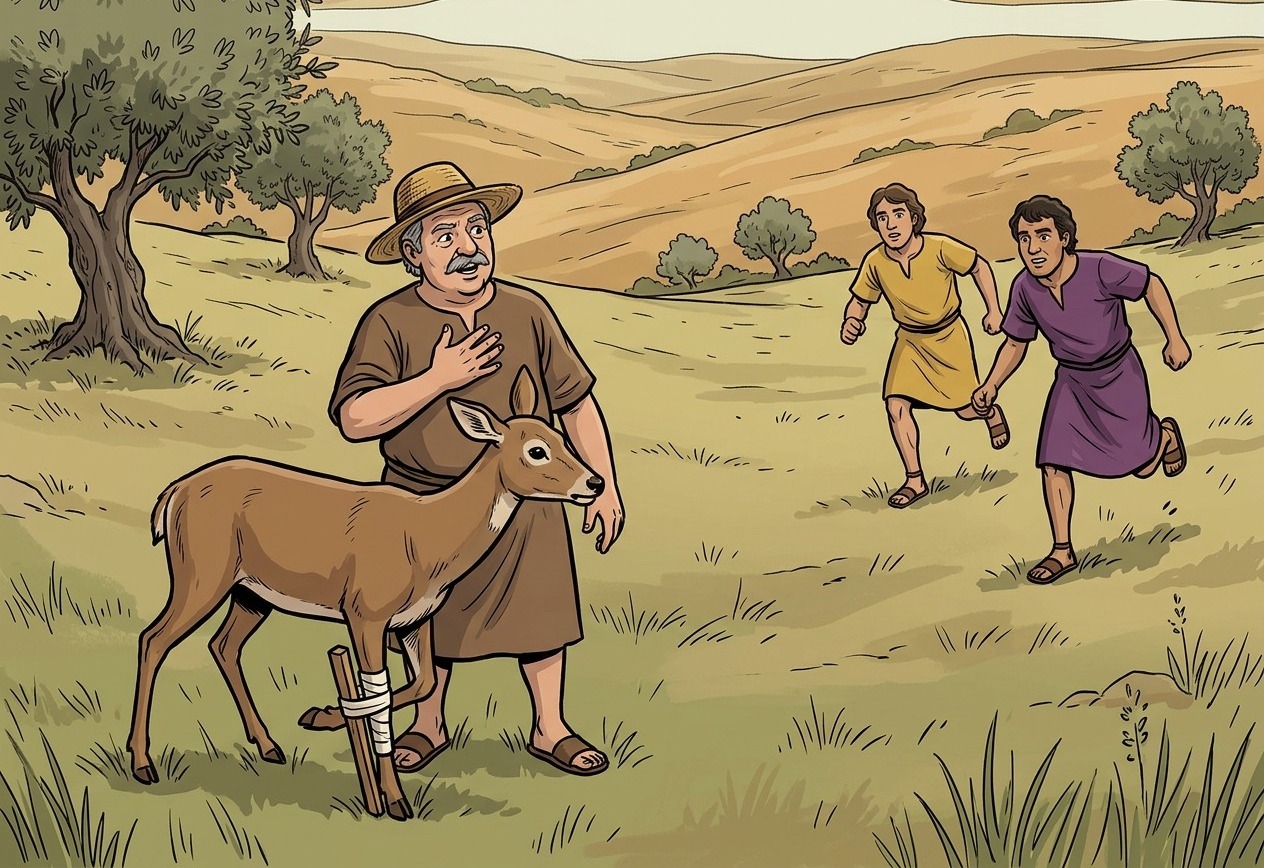
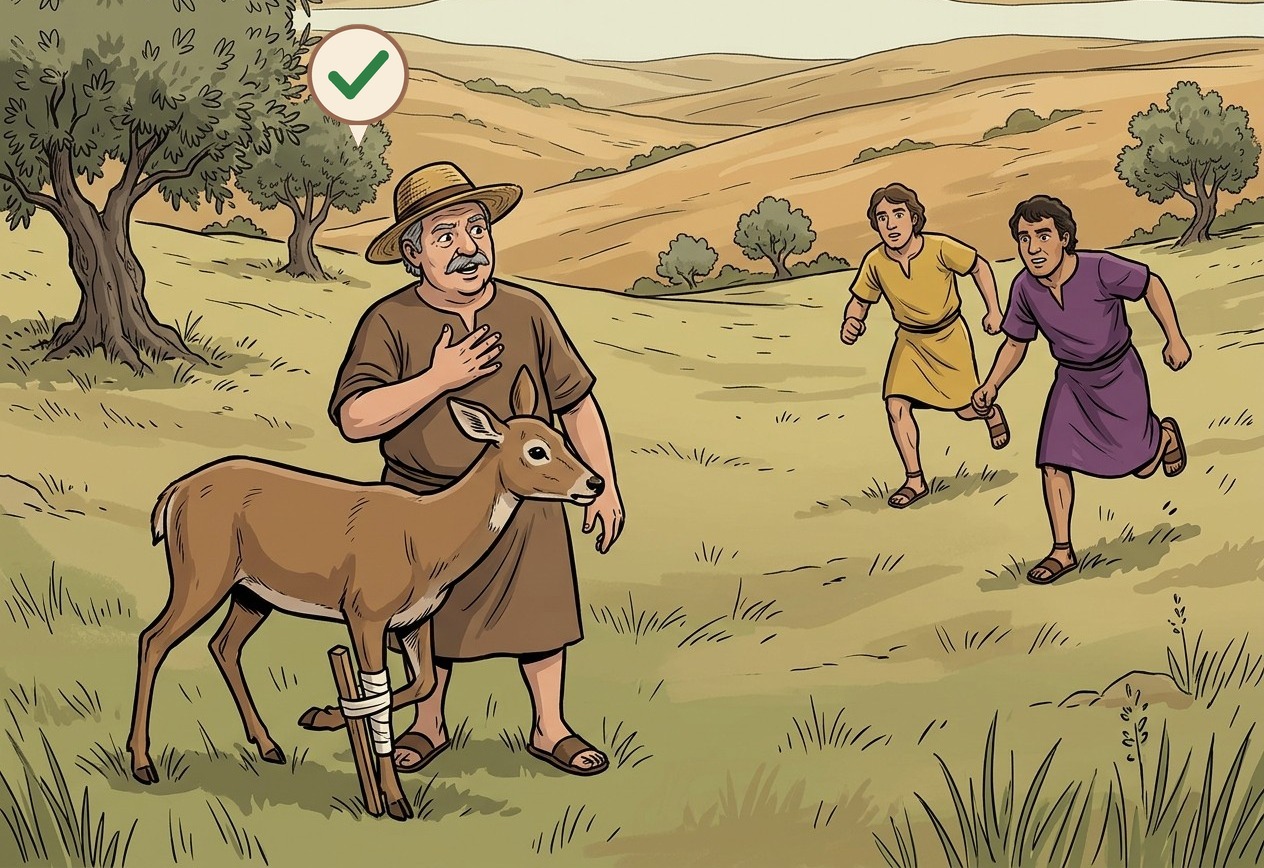
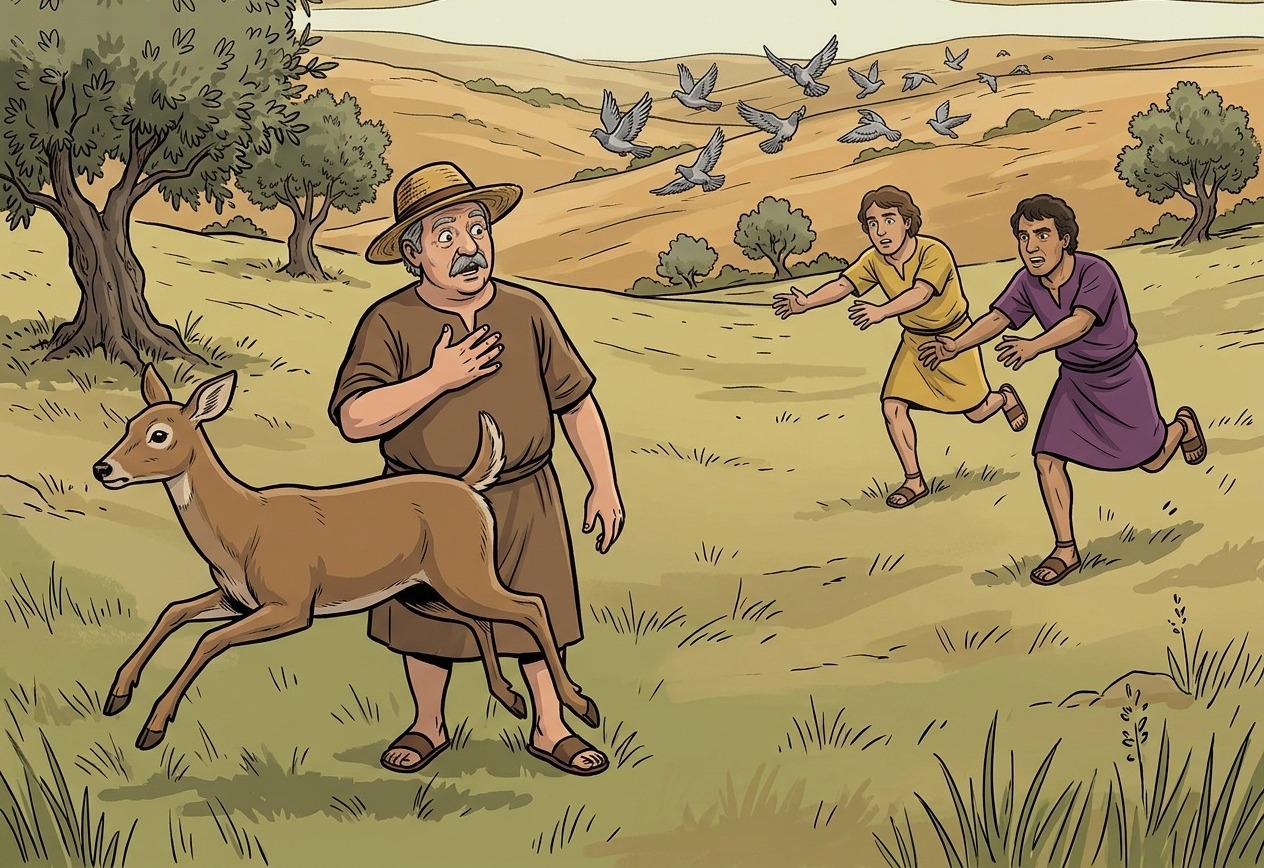
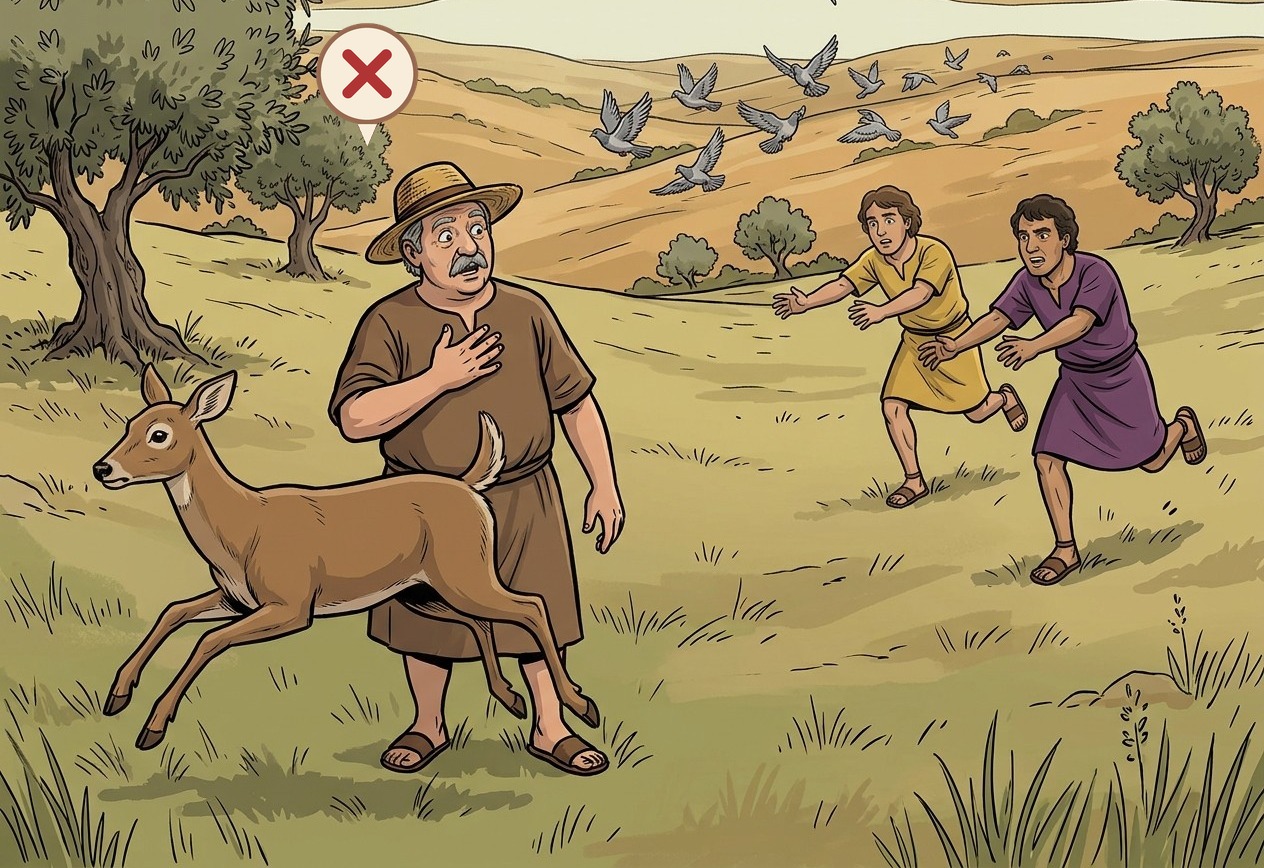
- He saw people running in his field after lost property, such as a deer with a broken leg or pigeons that cannot fly, and said "my field acquires it": he has acquired it.
- But if the deer was running normally or the pigeons flying, and he said it, he has said nothing.
Three conditions
- Others have not yet claimed it, the animal is physically unable to leave the field, and the owner of the field claims it.
Does the field acquire it?
| The animal | Result |
|---|---|
| Deer with a broken leg, or pigeons that cannot fly | The field acquires it |
| A deer running normally, or pigeons flying | He has said nothing |
 ?
?
 ?
?
 ?
?
 ?
?
R. Kulp's commentary
If a man saw people running [in his field] after lost property [such as] a deer with a broken leg, or pigeons that couldn’t fly, and he said, “My field acquires [them] for me”, he has acquired them. But if the deer was running normally or the pigeons flying, and he said, “My field acquires [them] for me”, he has said nothing. In this section we learn that under certain circumstances a person’s field can acquire something for him. In such a case the animal is acquired not by physical possession by the claimant but by the animal being on his field. If the person sees people running after a lost object in his field and that lost object cannot move off his field he can acquire it by saying that his field acquires it. If, however, the animal can run or fly and therefore is not “stuck” on the person’s field, the field cannot acquire the animal. In other words in order for the field to acquire the animal on behalf of its owner three conditions must be fulfilled: 1) other people have not claimed it (in the mishnah others are running after it but have not reached it; 2) the animal is physically unable to leave the field; 3) the owner of the field makes a claim of acquisition over the animal.
Questions for Further Thought: Mishnah four: If my animal runs onto another person’s field and the other person claims that his field acquires the animal for him, does the animal now belong to him? How can you figure out the answer to this question from the mishnah?
Mishnah 5: Who owns what a family member finds?
What those who are supported by him find belongs to him; what those who are independent of him find is their own.
Belongs to him
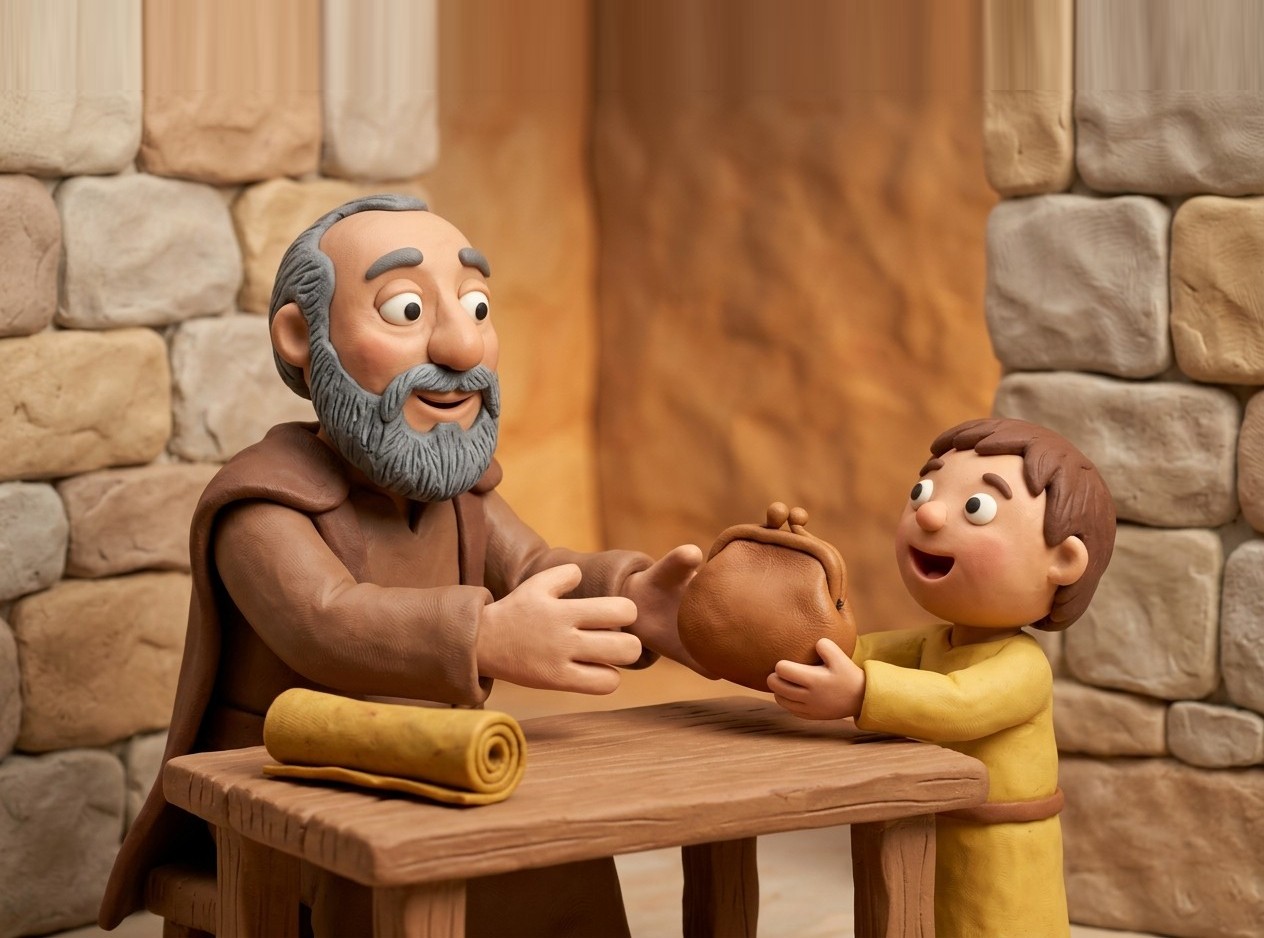
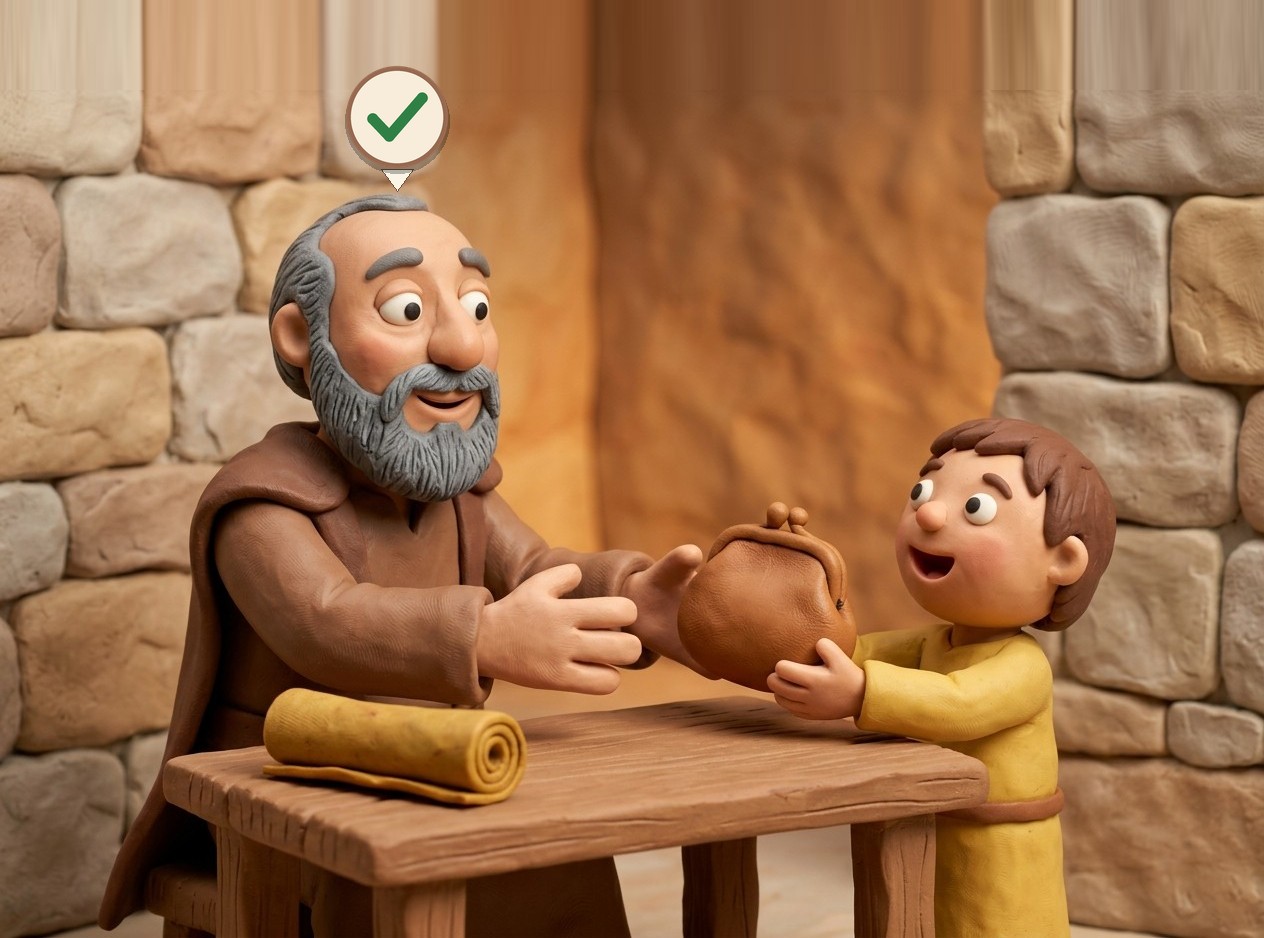
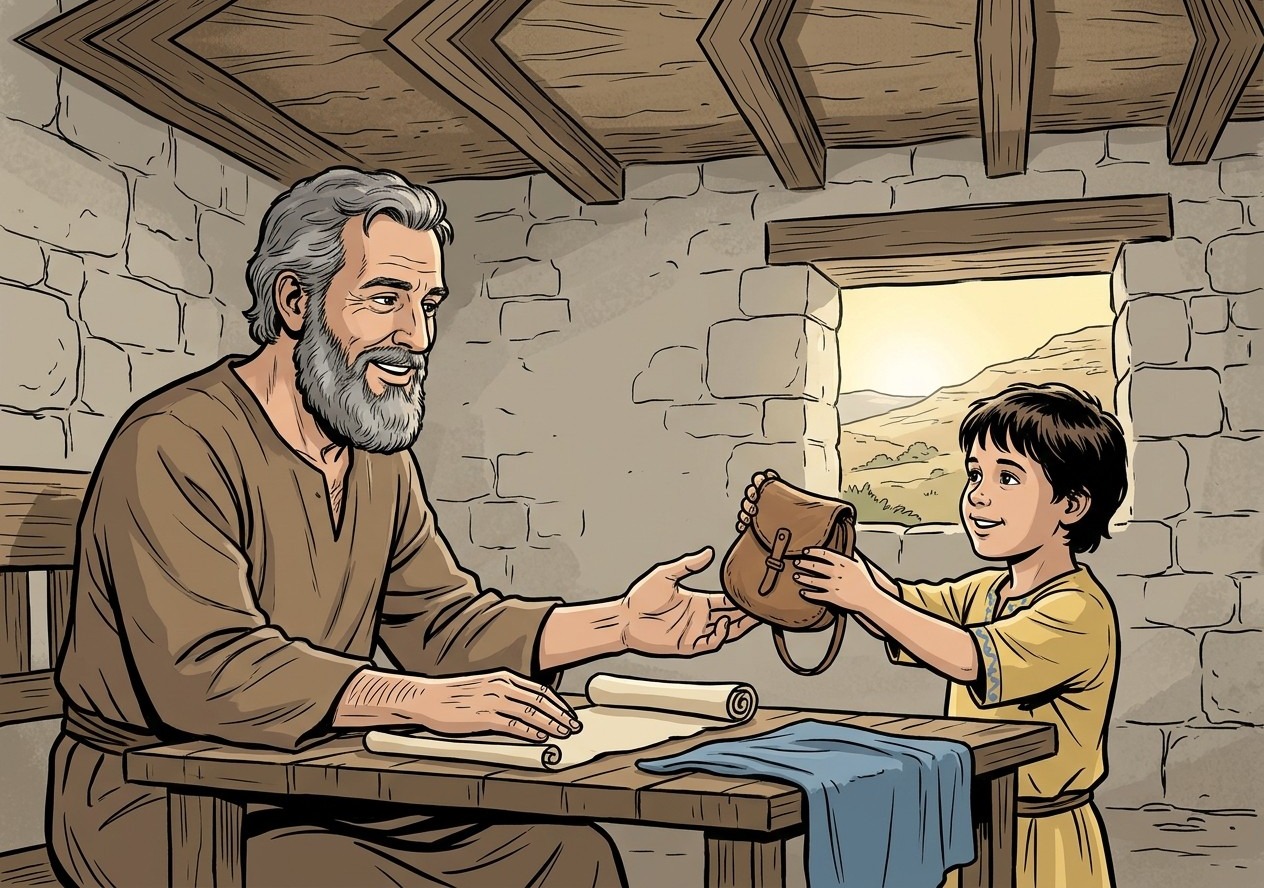
- What is found by his minor son or daughter, his Canaanite slave or female slave, or his wife.
- A father who supports his children can claim what they earn, including found objects; a Canaanite slave is wholly owned and cannot own property; a wife supported by her husband gives him her earnings.
Belongs to them
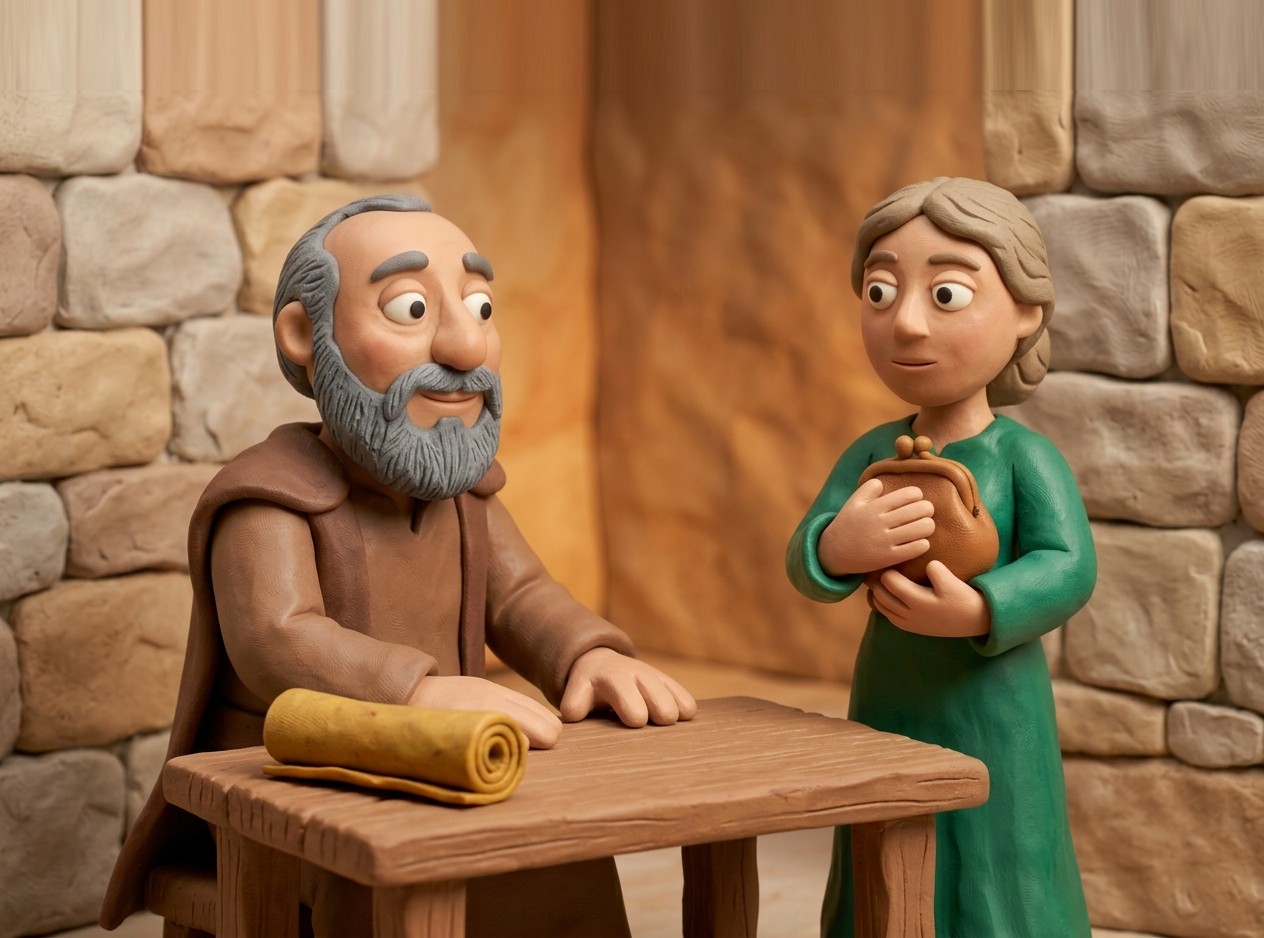
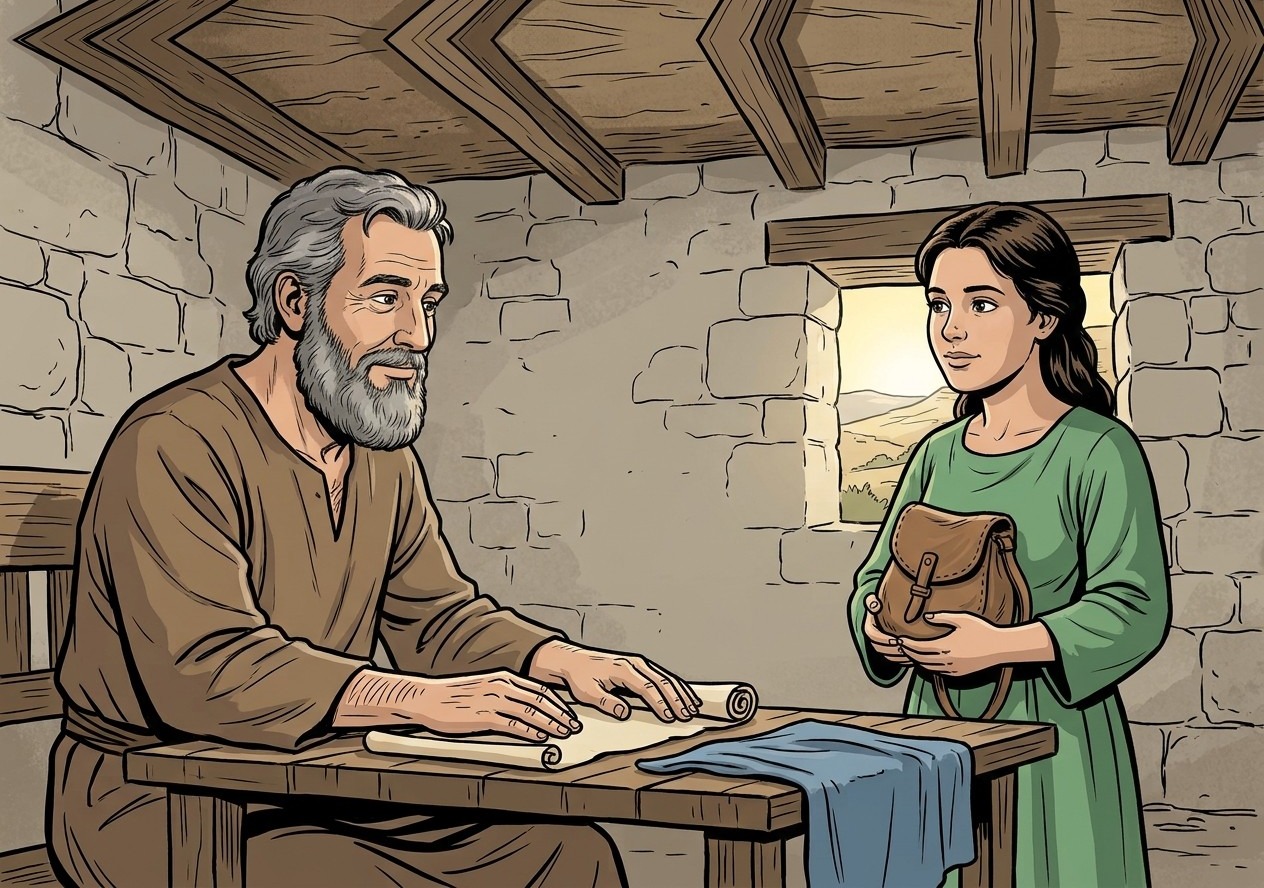
- What is found by his grown son or daughter, his Hebrew slave or female slave, or his divorced wife, even if he has not yet paid her ketubah.
- A father's control does not extend to adult children he does not support; a Hebrew slave is like a hired worker; a divorced woman owes him no earnings.
 ?
?
 ?
?
 ?
?
 ?
?
R. Kulp's commentary
That which is found by a man’s minor son or daughter, and that which is found by his Canaanite slave or female slave, and that which is found by his wife belongs to him. A father (assumed in the Mishnah to be the head of the household) who is financially supporting his children can claim ownership over any financial benefit they might bring him including, as we learn here, found objects. In other words in return for his financial support, they must give him any of their earnings. A Canaanite (i.e. non-Jewish) slave or female slave is totally owned by their owner. They do not have the ability to own possessions and therefore anything they find belongs to their master. Finally, a married woman who is receiving financial support from her husband, gives him in return any of her earnings, including found objects. Note, that the relationship between a father and his children and a husband and his wife is one in which the latter are guaranteed support, even if they earn nothing. In such a familial structure allowing the child or wife to keep found objects while still receiving financial support from their father/husband may cause him to resent them, ultimately to their detriment.
That which is found by his son or daughter that are of age, and that which is found by his Hebrew slave or female slave, and that which is found by his wife whom he has divorced, even though he has not yet paid her ketubah, belongs to them. On the other hand, a father’s financial control over his children does not extend to his adult children who are not supported by him. What they find belongs to them. Also, a Hebrew slave is treated in the Mishnah to be more similar to a hired worker who can own his own possession. Anything the slave finds therefore, belongs to him/her. Finally, a divorced woman does not owe her husband any financial gains she accrues after the divorce. This is true even if he has not paid her ketubah, meaning the divorce settlement. In such a case he is still obligated to provide her with food, clothing and shelter. Nevertheless, since he divorced her, he does not receive any object she might find.
Questions for Further Thought: • Mishnah five: Why doesn’t the mishnah say that as long as the husband has not given his divorcee her ketubah and is therefore supporting her, he would receive any object which she found? What might be a problem caused by such a law?
Mishnah 6: Found debt documents
Whether to return a found loan document depends on whether it records a lien on the debtor's property.
A lien on the debtor's property
- He should not return it, since the court would collect repayment from the property.
No lien
- Rabbi Meir: he may return it, since the court would not collect from the property.
- The Sages: in either case he should not return it, since in either case the court would collect from the property.
R. Kulp's commentary
Questions for Further Thought: • Mishnah six: According to Rabbi Meir, if one finds a debt document in which there is no lien, he may return it to the creditor. Why is he allowed to do so, and why would you think he should not?
Mishnah 7: Found documents of giving
Documents that give something to another person are not returned, since the writer may have changed his mind.
Do not return
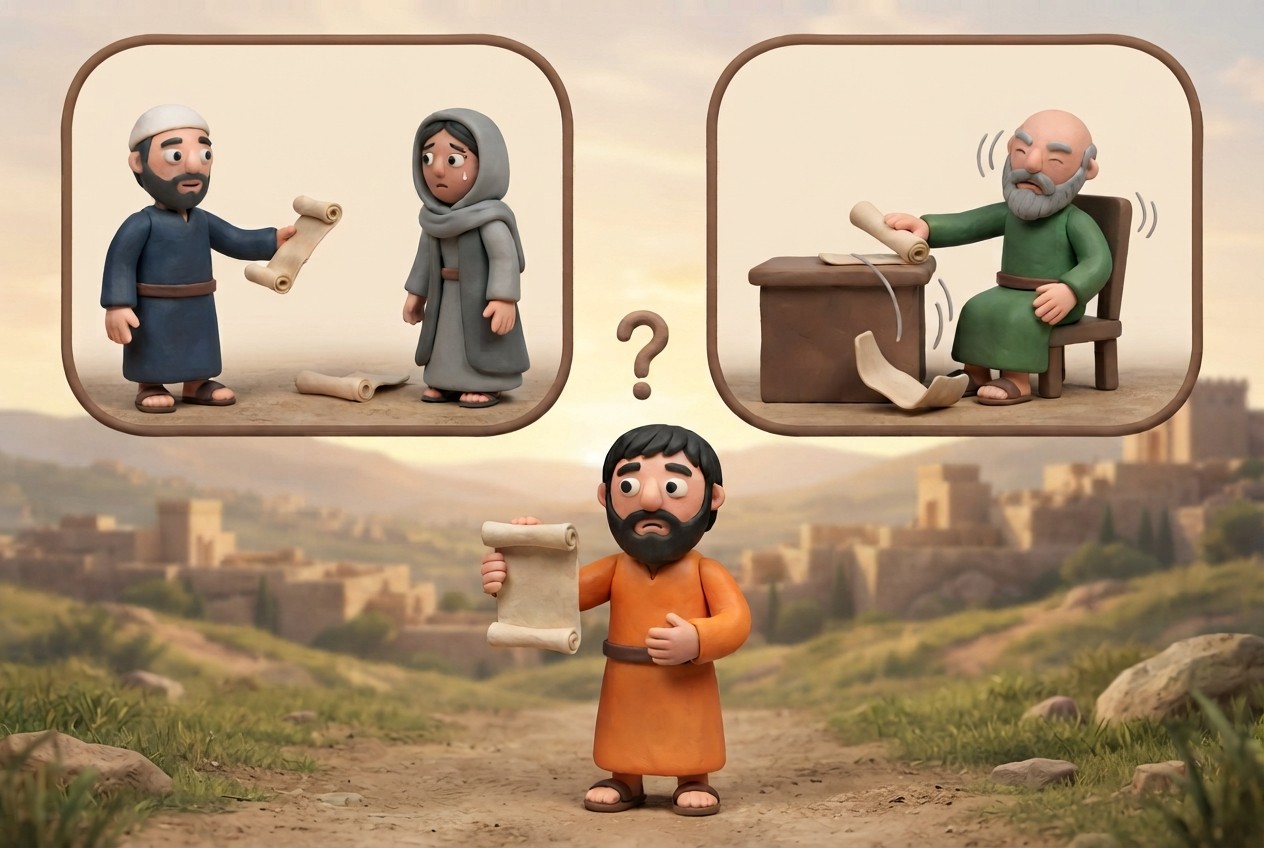
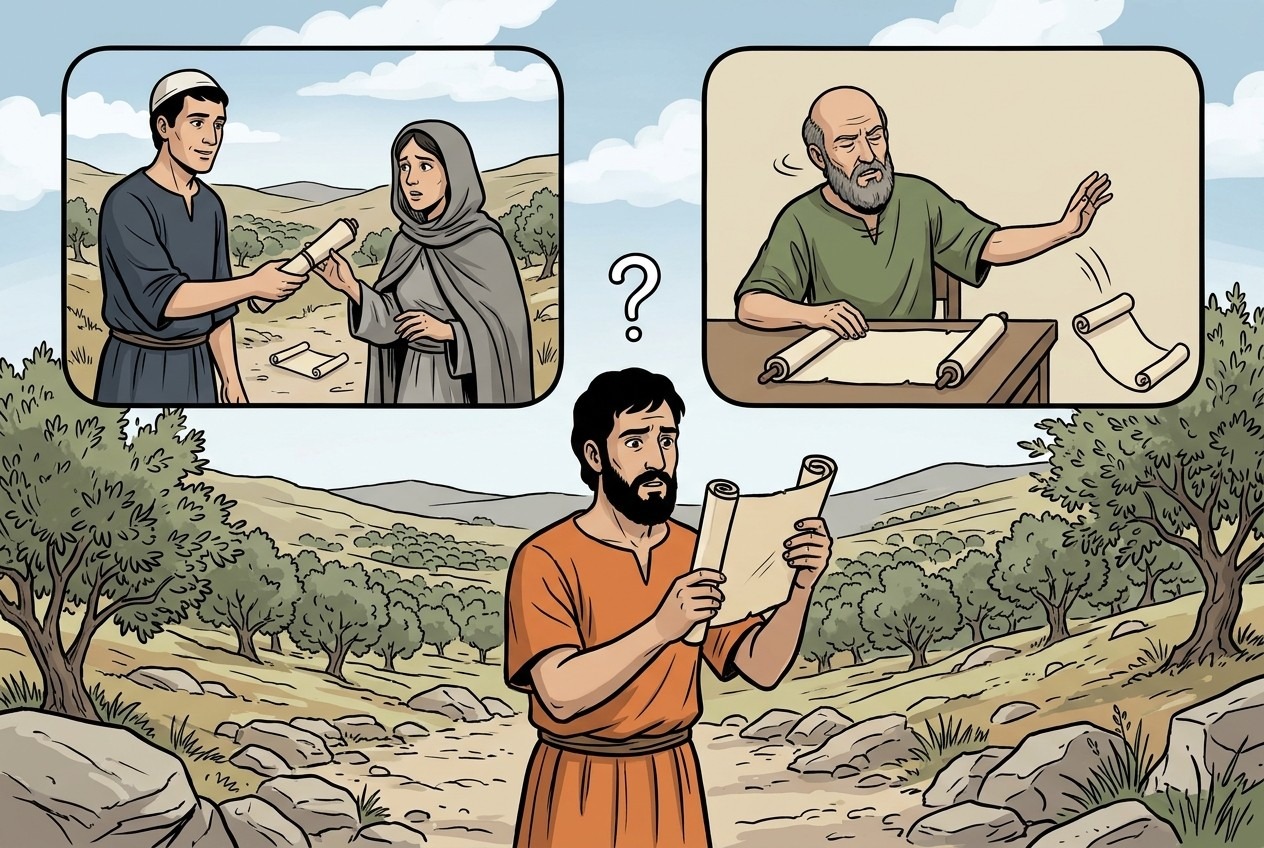
- A man who found bills of divorce, writs of emancipation, wills, deeds of gift or receipts should not return them.
- The writer may have written one and then changed his mind and decided not to give it.
- These documents are normally kept by the recipient, so one might expect to return them to him, but we cannot be sure the recipient lost it.
 ?
?
 ?
?
R. Kulp's commentary
If a man found bills of divorce, or writs of emancipation or wills, or deeds of gifts, or receipts, he should not return them, for I might say, “they were written out, and the writer might have changed his mind and decided not to give them.” In this short mishnah are listed types of documents where one person gives something to another person, whether it be a divorce given to a wife by her husband, freedom to a slave from his master, inheritance to an inheritor, a present, or a receipt. These documents would normally be kept by the recipient. If one of these was found one might have expected to return it to the recipient, i.e. the wife, slave, etc. However, the mishnah states that they should not be returned. Since it is possible that the writer wrote the document and subsequently changed his mind and did not give the document, we cannot be sure that the recipient lost it.
Questions for Further Thought: If the giver of one of the documents mentioned in this mishnah told the finder that he had indeed given the document to the recipient, would the finder then return it to the recipient? How is this different from the case in the previous mishnah?
Mishnah 8: Documents that are returned, and the one that waits for Elijah
Which found documents are returned, and what to do with one of unknown nature.
Return them
- Letters of evaluation or sustenance, documents of halitzah or refusal, documents of arbitration, and any document drawn up by the court.
- Documents found in a satchel or bag, or a bundle of documents (three tied together).
- If it is an identifiable bag, return them to the person who can identify it.
Rabban Shimon ben Gamaliel
- Three documents in which one man borrowed from three others: return them to the borrower.
- Three documents in which one man lent to three: return them to the lender.
- A set of three documents with the same name was probably lost by that named person.
Not sure, and the simpon
- A document of unknown nature found among his own documents is left until Elijah comes: he may neither discard it nor give it to creditor or debtor.
- If there are postscripts with them, he does what the postscript says, even if the document is torn or unreadable.
R. Kulp's commentary
If he found documents in a satchel or bag, or a bundle of documents he should return them. How many count as a bundle of documents? Three tied up together. If a person finds documents in an identifiable bag he should return them to the person who can identify the bag. In the upcoming chapter we will learn about identifying lost objects.
Rabban Shimon ben Gamaliel says: [If one found three documents in which] one borrowed from three others, they should be returned to the borrower. But if [one found three documents in which] one loaned to three, they should be returned to the lender. A set of three documents found together and all containing one name, was in all likelihood lost by that named person. Therefore if three documents state that one person borrowed from three others, it is reasonable that they belonged to the borrower. If the three documents all contain the name of the same creditor who loaned to three different debtors, it is reasonable that the documents belonged to the creditor.
If a man found a document among his documents and he does not know what is its nature, it must be left until Elijah comes. If a person finds a document amongst his documents that contains the name of a creditor and a debtor, but he doesn’t know who gave him the document, and therefore he doesn’t know if it was paid off, he should hold the document until Elijah comes. In other words he shouldn’t get rid of the document but neither is he permitted to give it to either the creditor or the debtor.
If there were postscripts amongst them, he should do what is stated in the postscript. If he finds amongst his documents torn or unreadable documents which have with them postscripts which state what needs to be done with the document, he should do what is in the postscript, even though the document itself is torn or unreadable.
Questions for Further Thought: Mishnah eight, section two: Why in this case is the finder supposed to return the lost documents? Why don’t we worry that they were lost by the writer who changed his mind after writing them and before giving them?
Chapter summary
Draft from the mishnah and R. Kulp's commentary only (each item carries its mishnah number). To be deepened with Kehati. Definitions are provisional until AnyDaf's master glossary covers them.
Key principles
- Two people hold an object, each says it is his, and neither can prove it: each swears that he owns no less than half, and they split it. This applies whether they say 'I found it' or 'it's all mine'. 1:11:2
- If one claims all and the other claims half, the claimant of all swears he owns no less than three quarters, the claimant of half swears no less than a quarter, and they divide three quarters to a quarter. 1:1Why three quarters? The mishnah's own numbers suggest that the half nobody disputes is his, and the other half is split, but R. Kulp leaves this as a question, so it is to be confirmed from Kehati.
- Oaths are the tool when there are no witnesses; they work because oaths were taken extremely seriously. When both sides admit the other's claim, or witnesses testify, no oath is needed, since it is preferable to avoid oaths altogether. 1:11:2
- A claim of ownership over a found object must be made at the time of holding it, not after handing it to someone else. 1:3
- Falling on a found object does not acquire it: whoever seizes it acquires it. A person's field can acquire an animal for him only if three conditions hold: others have not yet claimed it, the animal physically cannot leave the field, and the owner declares that his field acquires it. 1:4
- What a person who is supported by him finds (minor children, Canaanite slave, wife) belongs to the supporter. What those independent of him find (adult children, a Hebrew slave, a divorced wife even before the ketubah is paid) is their own. 1:5
- Found documents are returned or not according to whether we can be sure the owner lost them. A found loan document that records a lien is not returned, since the court would collect from the property (the Sages say the same even without a lien; R. Meir disagrees, see below). Documents of giving (divorce, release of a slave, wills, gifts, receipts) are not returned, since the writer may have changed his mind and never given them. 1:61:7
- Returned: documents drawn up by the court and the like, documents found in an identifiable bag, and a bundle (three documents tied together) whose names point to who lost it. A document of unknown nature among one's own documents waits until Elijah comes; torn documents are handled as their postscripts say. 1:8
Key terms
- oath שבועה 1:11:2
- The means of testing the truth of a claim when there are no witnesses. Oaths were taken extremely seriously, and the assumption is that no one swears falsely.
- acquire (zakhah) זכה 1:31:4
- To gain title to an object. In 1:3 by holding it and claiming it at that moment; in 1:4 also through one's field.
- my field acquires it for me זכתה לי שדי 1:4
- A declaration by which a field's owner acquires an animal that is on his field and cannot leave it. It has no effect on an animal that can run or fly away.
- ketubah כתובה 1:5
- Here, the divorce settlement. Until it is paid, the husband still supports his divorced wife, yet he does not receive what she finds.
- Canaanite slave and Hebrew slave עבד כנעני, עבד עברי 1:5
- A Canaanite (non-Jewish) slave is wholly owned and cannot own property, so what he finds is his master's. A Hebrew slave is treated more like a hired worker who can own possessions, so what he finds is his own.
- lien (acharayut nekhasim) אחריות נכסים 1:6
- A document that records a lien on the debtor's property: the court would collect repayment from the property.
- postscript (simpon) סמפון 1:8
- A note attached to a document that states what must be done with it. The finder follows the postscript even if the document is torn or unreadable.
- until Elijah comes עד שיבוא אליהו 1:8
- The document is left as it is: the finder must neither discard it nor give it to the creditor or the debtor.
Key debates
Is a found loan document without a lien returned to the lender? 1:6
R. Meir: if it records no lien, he may return it, since the court would not collect from the property.
The Sages: in either case he does not return it, since in either case the court would collect from the property.
Three documents found together: whose are they? 1:8
Rabban Shimon ben Gamaliel adds: three documents in which one man borrowed from three others go back to the borrower; three in which one man lent to three go back to the lender. Kulp: a set of three documents with the same name was probably lost by that named person.
The mishnah's first statement: a bundle (three tied together) is returned. Kulp does not present Rabban Shimon ben Gamaliel's rule as a dispute with it.